CRM with Task Management: Turn Every Deal Into Clear Next Steps

You close the deal. The celebration pings light up, the team cheers, and then… momentum dies. Onboarding steps live in a separate project tool. The SOW is buried in an email thread. A week later, your new client asks for an update and you’re piecing it together from Slack, a spreadsheet, and someone’s memory.
Those gaps are expensive. Every missed task or delayed start compounds into real money and real risk:
- Late kickoffs push revenue recognition and burn trust on day one.
- Scope creep hides in the handoff and turns into write-offs.
- Duplicate data entry creates mistakes that require rework.
- Status chasing eats hours that never make it to the invoice.
Bitrix24 fixes the leak at its source. It’s a CRM with task management built in, so the second a deal is marked Won, your onboarding playbook launches as a real project — tasks, assignees, deadlines, files, and context already in place and linked to the deal. Sales and delivery work from the same record of truth, so nothing gets lost between pipeline and project. For agencies and consulting firms where margin lives in the handoff, that’s the difference between firefighting and predictable delivery.
Adopt fast, integrate smart, and scale safely
Changing tools shouldn’t stall your quarter.
Fast start, practical rollout:
- Use out-of-the-box CRM project templates or clone your current checklists into Bitrix24. Keep the names, steps, and owners your team already knows.
- Map your pipeline stages to onboarding automations — no code required. When a deal moves to Won, the right project launches; when a deal moves to "Scope Change", add a review task.
- Import contacts, deals, and tasks via CSV or native integrations. Bring in active clients first, then backfill historical records as you go.
- Connect email and calendars (Google, Microsoft) so communications and meetings sync to the correct deal and project automatically.

Keep deadlines with real planning tools
A task list without planning is a wish list.
Plan and execute with confidence:
- Gantt charts to visualize the project timeline, adjust dependencies, and shift schedules with drag-and-drop. Move one milestone and downstream tasks adjust automatically.
- Kanban boards to manage flow by stage — Backlog, In Progress, Blocked, Review, Done — and spot bottlenecks at a glance.
- Workload view to balance assignments across the team. See who’s overloaded next week and reassign work before deadlines slip.
- Time tracking on tasks to capture actuals vs. estimates. Protect margin by learning where estimates drift and tighten future bids.
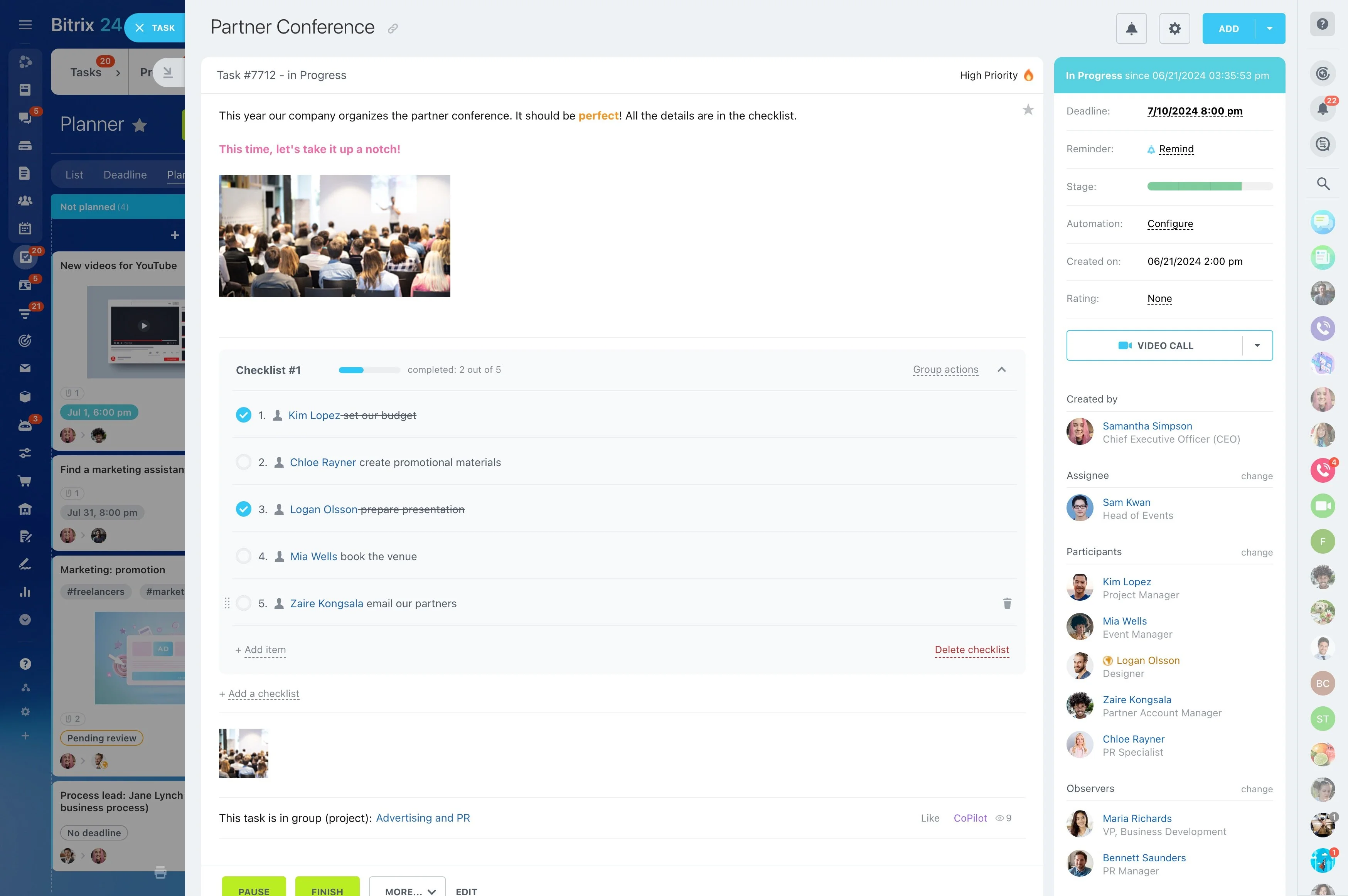
Turn every closed deal into a ready-made project
The most expensive words in services are "We’ll set that up tomorrow." Tomorrow is how scope slips, kickoffs drift, and clients cool.
Example: You sell a 10-page website package.
- You define project templates per service line — Website Build, Brand Sprint, SEO Retainer, Advisory Onboarding — each with tasks, subtasks, checklists, owners, and timelines.
- You set an automation in the CRM: when Deal Stage = Won (and optionally Pipeline = Agency > Website Build), create a project (workgroup) from the matching template.
- Owners are assigned by role (Account Manager, PM, Designer) or rules (deal owner, regional team). Notifications go out immediately so work starts the same day.
- Someone copies last year’s checklist, misses two steps, and the team rebuilds a module — 20 hours gone.

See sales and delivery on one screen
When tasks live in a separate app, you manage by rumor. "I think Creative started." "PM said they’re waiting on access." That’s not visibility — it’s guesswork.
One minute later, the client has a precise answer — and a reminder to send credentials.
- A task timeline with every to-do, subtask, comment, file, and status change — organized in context of the sale.
- Filters to spot risk fast: open items due this week, overdue actions, blockers waiting on the client, and exactly who’s on point.
- Linked communications: calls, emails, and chat threads tied to the right task or milestone (no more "Which thread has the logo?").
- Documents in one place: proposals, SOWs, briefs, and generated docs stored, versioned, and connected to the work that uses them.

Standardize onboarding with templates and checklists
If your onboarding depends on memory, it’s already broken.
Build repeatable playbooks across pipelines and products:
- Task templates by service line: Discovery, Kickoff, Access Collection, Creative Brief, Implementation, QA, Launch, Post-Launch Review. Each task carries owners, durations,…
- Checklists inside tasks to capture the small but critical steps: DNS and SSL, brand fonts and color codes, stakeholder roster, security approvals, sandbox vs. production URLs.
- Dependencies and subtasks ensure order: no launching ads before pixel verification, no migrations before content freeze. Guardrails prevent work from jumping ahead and creating rework.
- Recurring tasks for retainer rhythms: weekly standups, monthly reporting, quarterly roadmaps — automated so cadence work doesn’t go missing.

Collaborate without chaos—internals and clients
Handoffs rarely fail because people don’t care.
Built-in collaboration keeps teams and clients aligned:
- Task comments with mentions to capture decisions in the right place. @mention a designer on the "Homepage Wireframe" task and the answer lives with the asset forever.
- Built-in chat and video so you can jump from a deal or task to a quick call without switching tools. Share your screen, confirm next steps, and the summary stays attached.
- Approvals with trackable paths for creative, contracts, or deliverables. Route a concept to the CD, then the client, and see timestamps for each sign-off.
- Documents stored and versioned in Bitrix24.Drive. Generate scopes or status docs from CRM data, attach them to tasks, and avoid "Which version is final?" confusion.

Measure margins from won to delivered
If you can’t see delivery against revenue, you can’t protect margin.
In one dashboard, compare average onboarding duration, the percent of tasks overdue at handoff, and time-over-estimate on Design.
- Task Efficiency and on-time completion by team, project, and service line — so you know which playbooks run tight and which bleed time.
- Actual time vs. estimates to refine pricing and stop scope creep early. See where "small changes" regularly add 20% effort.
- Cycle time from Deal Won to First Value Delivered to prove onboarding speed and find slow steps.
- Pipeline-to-project conversion and throughput to spot stalls before they become escalations.
