Hospitality Industry CRM: Analyzing Bitrix24’s Features for Service Excellence


TL;DR (Quick Summary)
- Guest data scattered across booking systems, inboxes, and someone's memory is what breaks service, not a shortage of records.
- Bitrix24 fixes the coordination problem by connecting guest communication, CRM data, tasks, and follow-up (though it works as the layer around your PMS, not a replacement for one).
Takeaway: Bitrix24 fixes the coordination problem by connecting guest communication, CRM data, tasks, and follow-up, but it works as the layer around your PMS, not a replacement for one.
Hotels capture more guest data than almost any other business, across more systems than almost any other business. A PMS, a booking engine, a POS, a marketing platform, a notes field from three visits ago. Trouble is, none of them talk to each other well enough for the person at the desk to see the whole guest when it matters most…
Bitrix24 connects communication, tasks, and follow-up around the CRM record so information doesn't die in the handoff between departments. It works as the layer around your existing systems, not a replacement for them.
Here's where it earns its place, where it falls short, and how to test it before you commit.
Hospitality industry CRM: Why general-purpose customer management often falls short
Hospitality brands juggle relationships across far more touchpoints than a standard sales-driven business. One guest might discover a property through an ad, submit an inquiry, book a room, request a transfer, dine on-site, visit the spa, report a problem, leave a review, and come back months later for an event.
Every one of those interactions moves revenue and shapes what the guest thinks of the property.
The relationship continues after the sale
A general-purpose CRM is built around lead stages, account ownership, and sales activity. That's the right shape when the goal is moving a prospect toward a purchase.
But, of course, hospitality doesn't stop at the booking.
Once the reservation is made, staff coordinate dozens of service interactions before, during, and after the stay. The late-arrival-and-crib problem from a moment ago is the everyday version of the failure: the CRM holds a customer record, but it hasn't helped anyone execute the stay.
What generic CRM often misses
A general customer-management platform captures the basics:
- Contact information
- Sales inquiries
- Emails and calls
- Marketing activity
- Deal or booking opportunities
Hospitality teams work off a wider set of context:
- Reservation and arrival status
- Room or service preferences
- Open guest requests
- Previous complaints
- Dining, spa, event, or upgrade interest
- Ownership of the next action
Strip that context out and employees are back to switching between apps, checking spreadsheets, and asking colleagues for updates.
The expensive misread is treating CRM as mainly a marketing and lead tool. In hospitality, customer information also drives service execution, retention, and the simple act of recognizing a guest who's been here before.
Hospitality Guest Journey Automation Blueprint (Bitrix24 Ready)
Enter your email address to get a comprehensive, step-by-step guide

What is a hospitality CRM? A clear definition in business terms
A hospitality CRM pulls guest profiles, booking history, communication, preferences, service interactions, and revenue opportunities into one usable relationship record.
It helps teams recognize returning guests, coordinate internally, personalize the right interactions, and generate repeat business.
Hospitality CRM vs. PMS vs. Booking Engine
A hospitality CRM plays a different role from a property management system or a booking engine.
|
System Type |
Primary Data Scope |
Operational Visibility |
Guest Experience Relevance |
|---|---|---|---|
|
Hospitality CRM |
Profiles, preferences, interactions, segmentation, lifecycle revenue |
Cross-functional relationship view |
High for personalization and retention |
|
General CRM |
Contacts, leads, deals, communications |
Mainly sales and follow-up activity |
Moderate unless customized deeply |
|
PMS |
Reservations, room assignment, check-in/out, billing |
Property and stay operations |
High for stay execution, lower for long-term relationship management |
|
Booking Engine |
Search, availability, reservation capture |
Limited to transaction entry point |
Narrow, mostly pre-stay conversion |
Why hospitality businesses need CRM beyond contact management
Guests don't stay inside one channel. An inquiry starts on social media, moves to email, jumps to a phone call, and finishes in person at the desk. When every interaction spawns its own record, staff end up reconstructing the journey by hand.
Better service continuity
Connected guest data holds the thread between pre-stay communication, on-property service, and post-stay follow-up. It matters when a guest has already requested an accessibility accommodation, shifted an arrival time, flagged a service issue, discussed an upgrade, or asked about an event or restaurant booking.
Frontline staff shouldn't have to dig through five systems to find out what already happened.
Better commercial context
A guest record that carries past room type, restaurant visits, spa interest, event inquiries, and previous offers gives sales and marketing far more to work with than a profile holding an email address and a last-booking date. The commercial case for that depth is measurable: loyalty members accounted for 52.8% of occupied rooms in 2024, far outpacing overall US demand growth of 1.2% that year.
Guests who feel recognised come back. A CRM that helps staff deliver that recognition is doing commercial work, not just service work.
Where disconnected guest data goes wrong
A 2025 Hapi/Revinate survey of nearly 200 hospitality professionals found that 49% struggle to access the data needed for critical revenue and operational decisions, and 40% name disconnected systems as the biggest obstacle.
The failure modes behind those numbers are consistent. Duplicate profiles pile up because channels capture different email addresses or phone numbers. Service notes stay trapped in individual inboxes. The front desk misses a complaint from the previous stay. Marketing fires off an offer that contradicts what the property already knows. Dining, upgrades, events, and wellness activity drift free of the wider guest relationship.
A sales team can usually absorb a delayed CRM update. A front desk with a guest standing in front of it can't. Hospitality raises the operational cost of stale information.
Pro Tip
Decide which data is genuinely useful before you build dozens of preference fields. Room preferences, accessibility requirements, communication consent, VIP status, unresolved service issues, and high-value service interests earn structured fields. Minor one-off observations belong in activity history or notes.
Contact management is the floor, not the goal. A useful CRM helps employees coordinate service and read the relationship across visits.

How Bitrix24 fits the hospitality CRM model
Bitrix24 isn't a hospitality-only CRM. The platform bundles CRM, workflow automation, task management, collaboration, reporting, and internal communication. For hospitality, its place is the customer and workflow layer wrapped around specialist property systems.
Where Bitrix24 adds value
Its strength is tying guest-facing communication to internal action. A property can use it to:
- Capture inquiries
- Create CRM records
- Route work to employees
- Schedule follow-ups
- Track communication
- Create internal tasks
- Keep related activity attached to the customer or deal
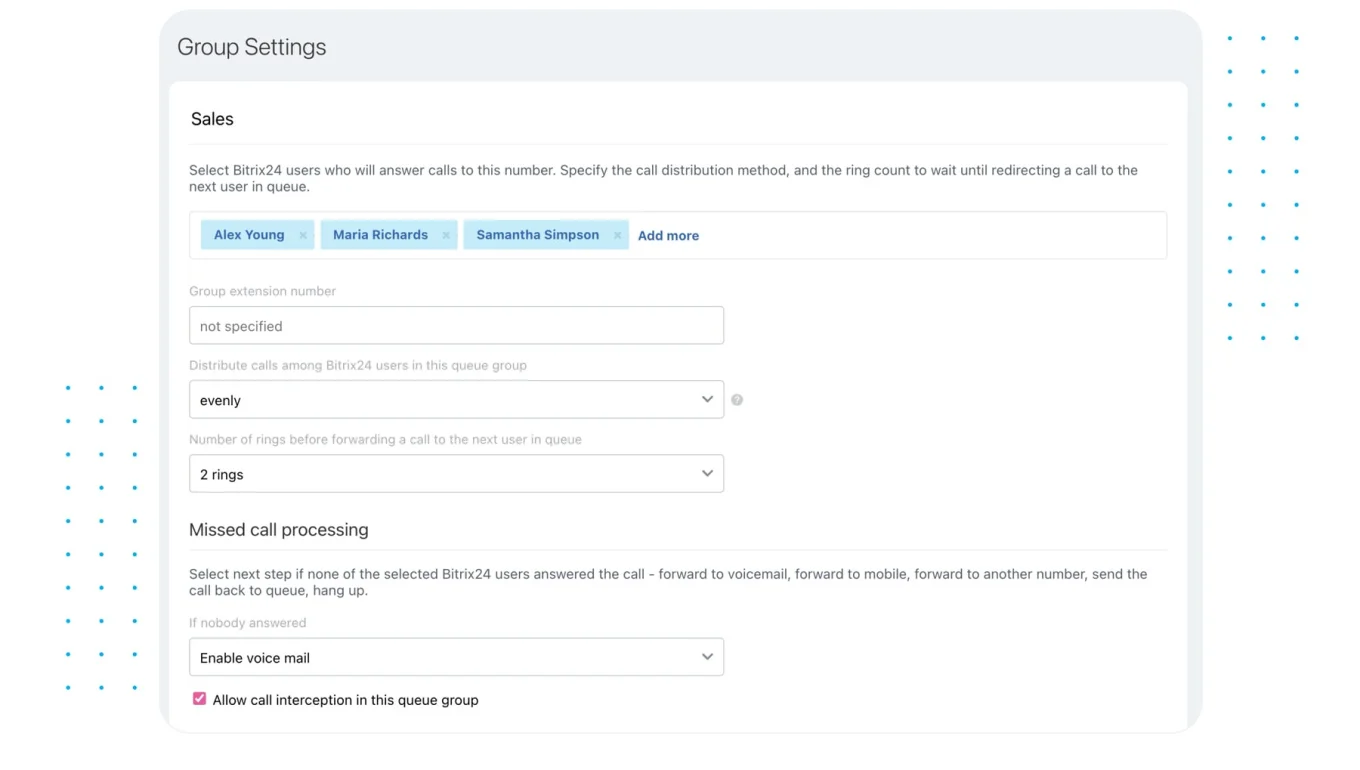
The Bitrix24 Contact Center pulls channels such as email, live chat, telephony, CRM forms, and supported messaging services closer to the CRM record. For operators fielding inquiries across half a dozen channels, that alone cuts a lot of manual copying between inboxes and customer records.
Where it fits naturally
A hotel or resort can run these through Bitrix24:
- Reservation and package inquiries
- Group and event leads
- Corporate travel accounts
- Special-request workflows
- Complaint and service-recovery cases
- Guest follow-up
- Post-stay campaigns
- Internal tasks linked to guest records
Restaurants and service properties can build the same kind of workflows for private dining inquiries, repeat guests, corporate bookings, event requests, customer issues, or marketing segments.
Where the limits start
The tradeoff is depth. Bitrix24 lets you configure CRM fields and processes around your workflows, and its custom CRM fields hold extra customer information when the standard fields run out. That flexibility still costs design work. Creating a field for room type or arrival date doesn't turn Bitrix24 into a hotel PMS.
Core hospitality CRM requirements and Bitrix24 feature analysis
Evaluate Bitrix24 against the operational requirements your teams actually depend on, not a generic CRM feature checklist.
|
Requirement |
Why It Matters in Hospitality |
Bitrix24 Capability |
Gaps or Customization Needs |
|---|---|---|---|
|
Guest data and personalization |
Supports recognition, tailored service, and repeat-booking strategy |
Custom fields, contact/deal history, notes, segmentation |
Preference models need clear structure and ownership |
|
Reservation integration |
Connects inquiries, stays, and follow-up to actual bookings |
APIs, apps, or connectors |
Deep PMS logic is not native; synchronization design matters |
|
Multi-service revenue |
Connects room, dining, spa, event, and upgrade opportunities |
Deals, pipelines, tasks, custom processes, workflows |
Cross-service data model must be planned carefully |
|
Omnichannel communication |
Guests move across email, phone, chat, and messaging channels |
Contact center and communication tracking |
Record quality depends on channel configuration and staff discipline |
|
Loyalty and retention |
Requires useful segmentation and relevant outreach |
Campaigns, CRM history, lists, automation |
It isn't a full hotel loyalty engine by default |
|
Staff coordination and analytics |
Service quality relies on clear ownership and handoffs |
Tasks, workgroups, notifications, workflows, reports |
Hospitality KPIs and escalation rules require configuration |
Guest data and personalization
Bitrix24 stores stay preferences, VIP status, prior complaints, package interests, and preferred communication channels through custom CRM fields and activity history. The storage is the easy part. Governance is where it breaks.
Someone has to decide:
- What each field means
- Who updates it
- When outdated information gets removed
- Which employees can see it
- Which fields feed segmentation or automation
Skip that and a preference logged three years ago gets treated as gospel today.
Free-text overload is the usual culprit. One employee writes "prefers upper floors," another writes "high floor," a third drops the same note somewhere else, and your segmentation stops meaning anything. Reserve structured fields for information staff need to filter or act on repeatedly.
Reservation and PMS integration
If an inquiry lands in Bitrix24 but the resulting reservation stays locked in the PMS, the CRM shows half the journey. Marketing knows someone asked for information but not whether they ever checked in. Guest services sees an old inquiry and misses that the arrival date moved yesterday.
The integration question isn't whether to connect the systems; it's what flows which way and how fast. A one-way feed of confirmed bookings works for some operations. Service-heavy workflows need updates running both directions, close to real time. Bitrix24's integrations and API options support that, but the design has to answer the operational questions before anything gets built:
- Which system owns the reservation record?
- Which system owns guest preferences?
- How are duplicate profiles handled?
- How fast must updates appear?
- What happens when an integration fails?
- Who checks failed or unmatched records?
Service requests and internal coordination
Communication and coordination are where Bitrix24 is strongest. A guest request becomes an internal task tied to the CRM record, and automation rules generate tasks at set points in a workflow.
An early check-in request creates a task for operations. A complaint hitting an escalation stage creates a follow-up for guest relations. An event inquiry reaching the qualified stage triggers a task for the events team. A VIP arrival generates a pre-arrival checklist across the relevant departments. Running this through Bitrix24 task management gives managers real ownership instead of a request buried in an email thread.
Pro Tip
Set service-task deadlines around the guest journey, not generic office SLAs. A transport request due before tomorrow's airport pickup and a post-stay survey task shouldn't run on the same priority rules.
Reporting and revenue context
Decide what you want reporting to answer before you build it. Useful questions:
- Which inquiry sources turn into confirmed business?
- How many service cases stay unresolved at departure?
- Which guests or accounts drive repeat event inquiries?
- Which campaigns produce return bookings?
- Which departments absorb the most escalated requests?
Bitrix24 includes CRM analytics and reporting, but property-specific measures often need data from the PMS, POS, booking engine, or other systems to be complete.

Common mistakes when evaluating CRM for hotels, resorts, and service properties
The first mistake is judging a CRM through a lead-management lens. Pipeline stages, lead scoring, and email logging all matter. But a hotel can have flawless inquiry tracking and still deliver ragged service when guest history, service requests, and internal handoffs stay disconnected.
#1: Assuming every guest interaction belongs in one pipeline
Sales opportunities and service requests behave nothing alike. An event inquiry moves through qualification, proposal, negotiation, and confirmation. A complaint moves through acknowledgement, investigation, resolution, and follow-up. Force both through the same stages and you get clutter and useless reporting.
Separate pipelines or custom processes are easier to manage when the work has different owners and different outcomes.
#2: Underestimating integration work
Hospitality CRM rarely stands alone. It sits beside:
- PMS platforms
- Booking engines
- POS systems
- Housekeeping applications
- Payment tools
- Marketing software
- Event systems
Keeping guest identity, booking status, permissions, and field definitions consistent as those systems change is the real operational problem. Picture a resort group that wants centralized customer history while each property runs its own operations. Let every property invent its own naming conventions and fields, and group-level reporting quietly falls apart.
#3: Overestimating out-of-the-box fit
Bitrix24 handles communication, workflows, and automation. Hospitality-specific logic still has to be built. Teams have to decide where APIs, custom fields, workflows, permission rules, or third-party platforms come into play.
#4: Automating a bad process
Automation hides weak process design instead of fixing it. When every trivial request spawns a stack of notifications, tasks, and escalations, staff start tuning out the alerts. When an automation dumps complaints into a general queue with no owner, the CRM logs activity and improves nothing. Start with ownership and decision rules. Add automation once the manual process makes sense.
Pro Tip
Before you approve a rollout, run one hard journey end to end: a reservation change, a VIP arrival request, a service complaint. Track what the guest says, which employee sees it, what record changes, who gets the next task, and what happens when someone blows the deadline.
A polished demo makes coverage look broad. The real test is whether a normal shift gets easier or messier.
Real-world hospitality use cases: Where Bitrix24 can deliver service excellence
Bitrix24 earns its keep wherever a guest interaction needs clear follow-up across people or departments.
Pre-booking and reservation inquiries
Inquiries pour in through web forms, email, calls, chat, social platforms, travel partners, and direct sales. A workable Bitrix24 process can:
- Capture or create the inquiry in CRM.
- Tag the relevant property or service.
- Assign an owner.
- Set a response deadline.
- Record follow-up activity.
- Connect the inquiry to booking information when it's available.
The practical headache shows up when guests use more than one channel. Someone submits a website form and calls an hour later. Without reliable matching rules, two employees work the same inquiry while the CRM quietly spawns duplicate guest records. That's why record matching and duplicate management matter as much as lead capture.
During-stay guest service coordination
A guest asks for early check-in before arrival, wants an extra amenity at check-in, moves the dinner reservation that afternoon, and needs transport the next morning. Four departments, one guest experience.
Bitrix24 works as the coordination layer here, creating linked tasks and keeping ownership visible. Front office, concierge, housekeeping, dining, and guest relations each work from their assigned actions instead of leaning on phone calls and verbal handoffs.
It still shouldn't turn into a second housekeeping or PMS platform. Tasks belong in Bitrix24 when they improve cross-team visibility. Room inventory and stay execution stay in the specialist system built for them.
Complaint handling and service recovery
Complaints make a sharp CRM test because ownership changes fast. A front desk employee takes the complaint, engineering investigates, a manager approves compensation, and guest relations follows up before checkout. Run that through email and every handoff is a chance for the case to stall.
A structured workflow gives the issue:
- One owner
- A severity level
- A response deadline
- Linked internal tasks
- Escalation rules
- Resolution notes
- A final follow-up status
For recurring or structured cases, Bitrix24 Smart Process Automation builds custom CRM items and workflows instead of jamming every issue into a standard sales deal.
Pro Tip
Keep service recovery separate from ordinary guest questions. A request for restaurant hours and a complaint about a failed airport transfer need different urgency, ownership, and reporting.
Post-stay retention and additional revenue
The post-stay phase is another clean fit. Segment guests on information you have permission to use, then schedule:
- Review requests
- Return-stay outreach
- Seasonal campaigns
- Relevant service offers
- Corporate account follow-up
- Event-planning reminders
The whole thing depends on connecting outreach to real guest history.
A generic "come back soon" email is trivial to automate. A campaign worth sending needs reliable information about the previous relationship. A resort tracking confirmed spa interest can build a segment for a wellness package. A corporate account with recurring event inquiries can enter a sales follow-up process ahead of its usual planning window.
These cases share a shape: Bitrix24 does its best work where the problem is communication, coordination, ownership, and follow-up, not specialized hotel transaction logic.

Scaling considerations, operational limits, and future trends in hospitality CRM
Growth turns governance into the main event. Multi-location brands need consistent guest-data definitions, access controls, workflow rules, and reporting. Let each property cook up its own version of "VIP status," "stay preference," or "complaint category" and centralized reporting starts to crumble.
Set data ownership before adding more properties
A growing group has to name which system owns each major data category. The PMS owns reservation and stay status. The CRM owns relationship history and approved segmentation. The POS owns food and beverage transactions. The service workflow owns issue ownership and resolution. The loyalty platform owns points, tiers, and entitlements. The exact split varies by operation, but leaving it undefined is what breeds duplicate and conflicting records.
Role-based permissions deserve the same attention once service notes carry personal information. Decide what staff genuinely need to see and configure access to match. Bitrix24 gives you configurable CRM permissions; the policy behind them is still yours to write.
Know where the platform should stop
Bitrix24 supports scaling across:
- Task routing
- Workflow standardization
- Communication
- Customer follow-up
- Cross-team visibility
Scale also exposes the ceiling. Deep PMS synchronization, room inventory, housekeeping logic, package entitlements, and property-specific stay operations aren't its job. Try to rebuild every hospitality function inside the CRM and you leave staff maintaining two versions of the same process.
A luxury resort group might need live stay status, dining activity, service entitlements, and preferences visible across properties. Bitrix24 can present and act on parts of that. The specialist systems still have to perform the underlying hotel operations.
The longer-term decision is partly architectural: can the platform trade clean information with the property, booking, service, and revenue systems you plan to keep?
FAQs
Can Bitrix24 replace a hotel PMS or reservation system, or does it work better as a CRM and workflow layer alongside those platforms?
In most hospitality environments, it works better as a CRM, communication, and workflow layer alongside a PMS or reservation system.
Core property functions such as room inventory, assignment, check-in, folio management, and stay execution belong in a system built for hotel operations. Bitrix24 earns its place in customer communication, follow-up, internal tasks, service workflows, sales opportunities, and relationship history.
Is Bitrix24 suitable for restaurants, boutique hotels, resorts, and multi-property groups equally, or does fit depend on service complexity and integration needs?
Fit tracks complexity closely.
Restaurants, small hospitality businesses, and boutique properties can often run Bitrix24 with fairly simple CRM and workflow configuration. Resorts with several revenue centers need a clearer data model and more integrations. Multi-property groups carry an extra governance burden: standardizing fields, permissions, workflows, and system ownership across locations while still letting individual properties handle local operations.
How should hospitality businesses think about guest personalization, data privacy, and omnichannel communication when using a customizable CRM platform?
Treat personalization as a data and governance problem before you treat it as a campaign feature.
Guest preferences, consent, communication history, service notes, and complaint records all need clear rules for collection, access, retention, and use. Staff should know:
- Which information belongs in structured CRM fields
- Which belongs in temporary operational notes
- Which shouldn't be recorded at all
- Who can access sensitive details
- Which information may feed automated communication
Channel consistency matters just as much. Email, phone, forms, chat, and messaging threads are only useful when teams can attach them to the right guest and see what's still outstanding.
Review platform permissions and your own legal obligations before storing sensitive customer information. Bitrix24 publishes information about its security controls, but each operator owns the call on what guest data its employees and connected systems collect and access.
Unify Guest Service Workflows in Bitrix24
Manage inquiries, tasks, guest history, and follow-ups in one workspace, so hospitality teams coordinate faster around your PMS.
Get Started NowIs Bitrix24 a good fit for your hospitality business?
Bitrix24 fits when the real problem is connecting guest communication, ownership, tasks, and follow-up across departments. It gives teams a shared layer around the PMS, booking engine, and specialist systems they already run on.
It's the wrong call if you need the CRM to hold room inventory, check-in logic, or folios. Those stay in the systems built for them.
The honest test is a broken journey, not a demo. Pick the guest request that crosses the most departments and watch whether Bitrix24 makes the handoffs cleaner or just adds another screen.The demo always looks clean. Start free and test the messy one.