Iterative Journey Improvement: Boost Every Stage of Your Funnel


Your worst funnel leaks hide in the gaps between stages. Four teams each tune their own metric while the customer moves through one continuous path, and the damage collects where their work meets. In fact, poor coordination between sales and marketing alone costs B2B companies an estimated 10% or more of annual revenue (and that's before counting the handoffs further down the funnel…)
Iterative journey improvement closes those gaps. It gives teams a repeatable way to find friction across the full funnel, fix it in controlled cycles, and turn what works into standard practice.
The key is treating awareness, consideration, purchase, onboarding, retention, and advocacy as one managed system rather than a stack of isolated channel reports. That way, teams can see where the journey breaks, who owns the fix, and whether the change improves the next milestone downstream.
This playbook shows how to stop treating funnel leaks as isolated problems and build a repeatable system for finding friction, fixing it, and making every stage work better with the next.
What iterative journey improvement actually means
Iterative journey improvement is a structured process: you repeatedly measure customer behavior at each funnel stage, spot friction or drop-off patterns, test targeted changes, and fold the winners into the live journey.
The operative phrase is "structured process." It goes well beyond CRO on a landing page or a quarterly strategy offsite.
The unit of work is a cross-functional improvement tied to a specific stage outcome. That might mean aligning ad copy with the landing page it points to, tightening lead-routing rules, redesigning onboarding steps, adding in-product nudges, adjusting lifecycle email timing, or triggering a support intervention for at-risk accounts.
Run improvement as a working cadence
In practice, the process runs on a cadence. A team reviews stage performance, gathers quantitative and qualitative evidence, decides which issues are worth acting on, ships a test or a direct fix, measures the impact, then either rolls the change into the standard journey or sends it back for rework.
Who runs it? Usually a weekly or biweekly working session with a named owner, not an open-ended project living in someone's head.
What separates it from broader strategy work is the operating discipline behind it:
- Defined stage metrics: conversion, activation, retention, expansion, advocacy
- Decision rules for what counts as a problem worth fixing
- Clear ownership for investigation, implementation, and follow-through
- A cadence, so issues don't sit in a dashboard for a quarter without action
Strategy sets direction. Iterative journey improvement is the day-to-day system that keeps the funnel moving.

Why journey optimization usually breaks in practice
Data lives in Silos
Most teams have plenty of data. What they lack is connected evidence.
Marketing data sits in ad platforms. Product behavior sits in analytics tools. Lead status and sales activity sit in the CRM. Support logs complaints in a ticketing system. Customer success tracks onboarding and churn risk somewhere else again. Each system explains part of the story, but no one sees the whole journey in a single operational view.
That fragmentation leads teams to optimize symptoms. A rise in trial drop-off gets treated as a landing-page problem. Weak expansion gets blamed on lifecycle email. Poor MQL-to-SQL conversion gets framed as a sales execution issue.
Sometimes those are the real causes. Often, the root problem sits upstream or downstream from where the symptom appears.
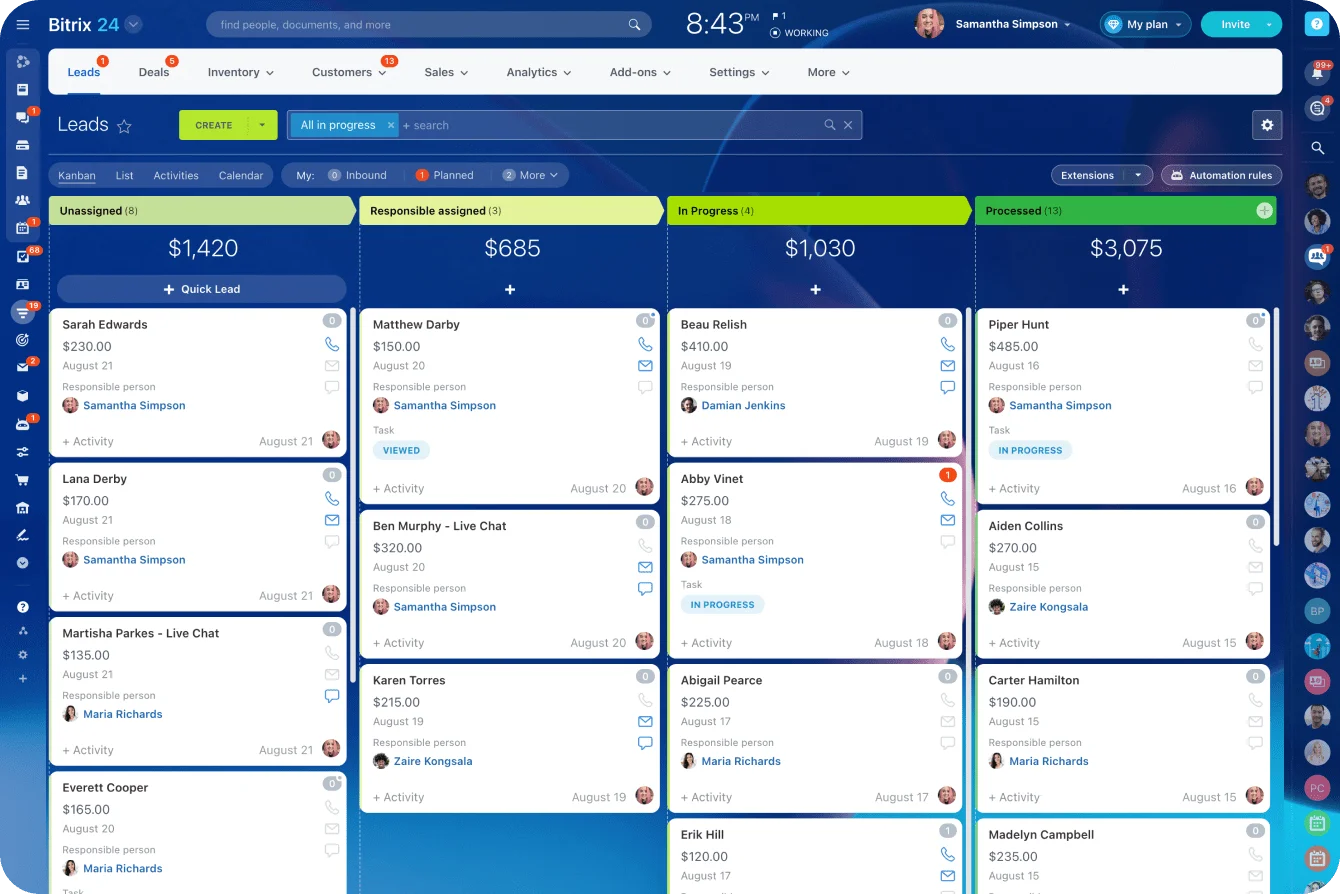
Pulling pipeline, activity, and lead status into one CRM removes at least the first layer of fragmentation, because teams can connect stage movement with ownership, follow-up, and outcome data.
Ownership blurs at the seams
The structure around the work tends to break at the same points. Ownership gets blurry exactly where the customer experience crosses functions.
Marketing owns acquisition. Product owns activation. Sales owns pipeline. Success owns retention. But nobody clearly owns the friction between them.
As Brian Balfour and his Reforge co-authors note, “it is common for companies to structure teams by layers of the funnel,” which is precisely how the seams between stages end up unowned.
When no one has authority over the journey itself, cross-team issues drift into backlog limbo.
Insights stall before they ship
Delay turns useful insight into stale work. A problem surfaces in one meeting, gets written up as tickets later, then competes against unrelated work in the product, lifecycle, or operations backlog. By the time the fix ships, the context may have shifted.
The execution itself adds its own failure modes:
- Too many local tests running at once, with no shared prioritization model
- Skipped control groups, or comparisons across periods with different traffic mixes
- Outcomes recorded informally, so nothing hardens into process, documentation, or automation
The result is motion without compounding.
Funnel Iteration Scorecard: Prioritize Fixes Across Every Stage
Enter your email address to get a comprehensive, step-by-step guide

The Iterative journey improvement framework: From signal capture to standardization
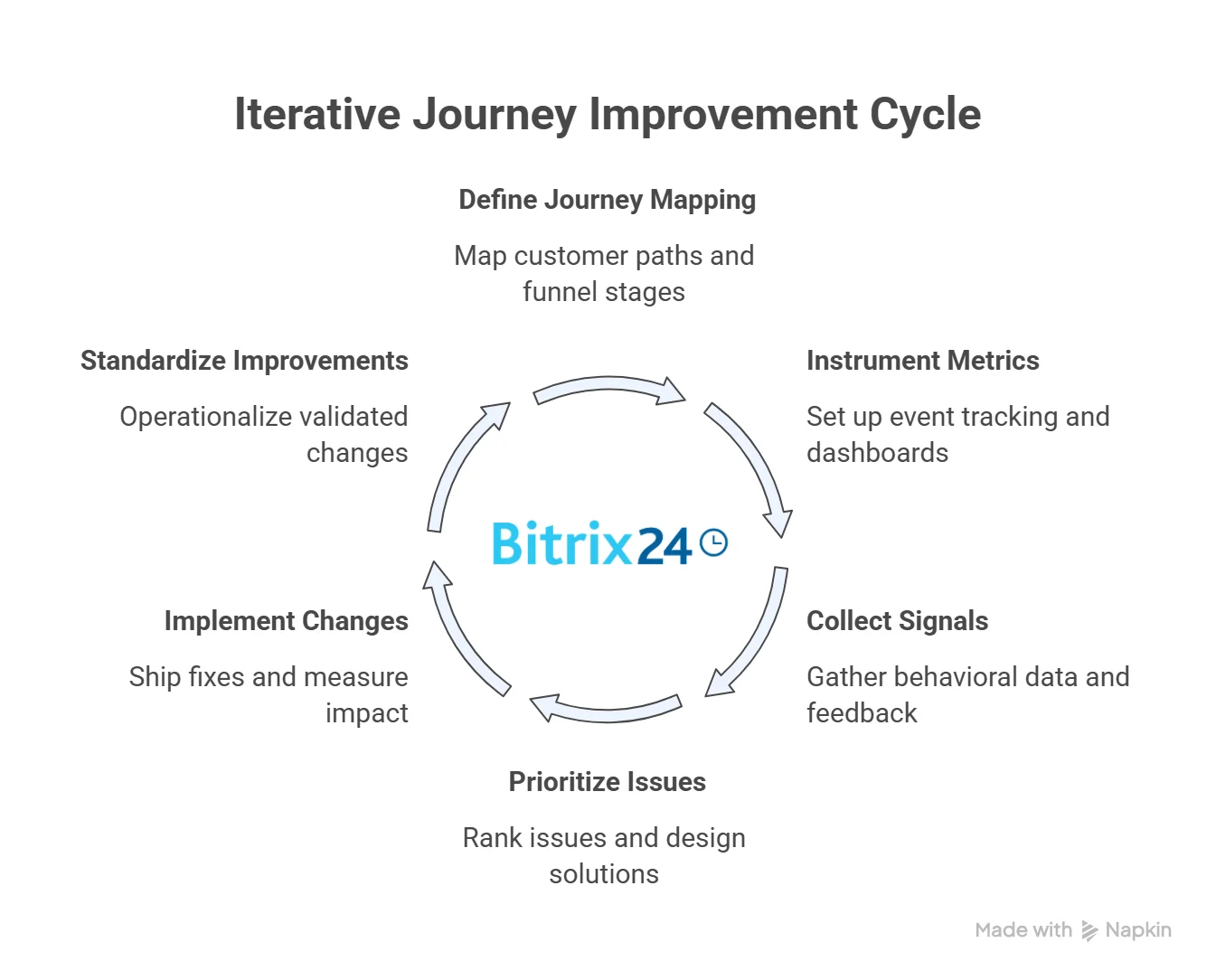
A working system needs a clear path from observation to permanent change. Otherwise, every issue becomes a one-off debate: Is this a real problem? Who owns it? Should we test it? Did the fix work? Has anything actually changed in the live journey?
The framework below keeps that movement disciplined. It shows how a team turns scattered signals into prioritized work, then turns validated fixes into standard practice.
|
Stage |
Primary Input |
Output Artifact |
Decision Gate |
|---|---|---|---|
|
Journey mapping and stage definitions |
Customer paths, handoffs, lifecycle states |
Shared journey map and stage criteria |
Are stages explicit enough to measure and assign? |
|
Baseline metric instrumentation |
Events, CRM fields, conversion points |
Trusted baseline dashboard |
Can teams see movement by stage and segment? |
|
Signal collection |
Behavior data, feedback, sales notes, support tickets |
Issue candidates and patterns |
Is there evidence of repeated friction or loss? |
|
Issue clustering |
Raw observations from multiple systems |
Problem statements with likely causes |
Is this one issue or several different ones? |
|
Prioritization |
Impact, effort, confidence, dependency data |
Ranked backlog |
Should this be tested now, monitored, or deferred? |
|
Experiment or fix design |
Problem statement, hypothesis, constraints |
Test plan or direct remediation plan |
Do we need a controlled test or an immediate operational fix? |
|
Implementation |
Approved plan, tickets, owners |
Live change with QA record |
Was the change launched correctly and fully? |
|
Measurement |
Post-launch data and comparison logic |
Performance readout |
Did the change improve the target stage and next milestone? |
|
Decision |
Readout and operational impact |
Scale, revise, rollback, or retest decision |
Is the result strong enough to operationalize? |
|
Rollout and standardization |
Validated improvement |
Updated journey, documentation, automation, training |
Has the learning been embedded into normal operations? |
Moving from signal to standardization
The table only works if teams respect the order. A signal should not jump straight to implementation just because it feels urgent. It needs a clear problem statement first. A test is not finished because one metric moved. It is finished when the result has been reviewed, the downstream impact is understood, and the winning change has been deployed into the live journey.
One rule keeps the flow honest: observations become tests when the issue is material, repeatable, and fixable. Tests become permanent when they improve the target stage without damaging the next milestone downstream.
Feed the learning back through the funnel
Feedback loops run both directions. Onboarding friction often starts with a promise made back in acquisition. A segment sold through one campaign may churn early because expectations were set wrong at the top.
In a mature system, that insight does not stay trapped in onboarding or success. It flows back into targeting, qualification, messaging, and sales enablement. A stage-conversion dashboard segmented by source makes those upstream and downstream links visible, so teams can fix the cause instead of repeatedly treating the symptom.
Roles, Ownership, and Handoffs Across Marketing, Product, Sales, and Success
This system only works when ownership is explicit. Someone has to own the journey backlog and the prioritization logic. In most companies, that is a growth lead, lifecycle lead, RevOps lead, or dedicated journey owner.
That person does not implement every fix. They maintain the queue, frame issues correctly, keep the decision rules consistent, and force a decision when work crosses departments.
Define who owns the system
The other ownership layers are more specialized:
- Channel and stage owners supply performance inputs and context
- RevOps or analytics owns instrumentation quality and reporting logic
- Product and engineering implement in-app and system changes
- Sales, support, and success capture frontline friction and recurring objections
Where the handoffs fail
The handoffs are where this usually falls apart. A few matter more than the rest.
Campaign to product expectations
If acquisition promises "set up in five minutes" but onboarding needs a data import and admin approval, conversion leaks right after signup. A B2B SaaS team running a "free in two clicks" ad against a product that requires SSO configuration will see exactly this gap.
Marketing should review major message changes with product or onboarding owners before they go live.
MQL to sales routing
Loose qualification or slow routing lets high-intent leads age out before anyone calls them. A sales team that lets weekend inbound leads sit until Monday will watch connect rates drop on those records.
This handoff needs clear criteria, an SLA on response time, and visibility into acceptance, rejection, and follow-up rates. Automated lead management can handle the routing and timing so a hot lead reaches the right rep in minutes rather than days.
Trial to onboarding activation
Plenty of teams lose users here because no one owns the first-value milestone. Sales assumes the account is self-serve, product assumes lifecycle automation covers it, and success gets pulled in too late.
The fix is explicit ownership by segment and trigger. That matters because poor onboarding accounts for roughly 23% of customer churn.
Support to product escalation
Support hears repeated blockers long before they show up in churn reports. Unless ticket themes are tagged, counted, and reviewed through a real escalation path, the signal stays anecdotal and dies in the queue.
Keeping governance light
Governance should make decisions clearer, not slower. Keep the structure practical:
- A weekly or biweekly journey review to inspect top issues and decide next actions
- A shared backlog with stage, impact, owner, status, and dependency fields
- RACI-style rules so "involved" does not get mistaken for "accountable"
- SLA expectations for cross-functional response on journey blockers
- An escalation path for issues that span teams or stall in a backlog standoff
The goal isn’t to create another committee; it’s to make sure cross-functional issues have somewhere to go, someone to own them, and a clear route to decision.

Automation, visibility, and control points that keep the system running
The tooling layer should support the workflow, not replace it. A strong setup does three jobs: it cuts delay between signal and action, keeps every team working from the same view, and protects the reliability of the decisions being made.
At a minimum, teams need analytics for stage conversion and path analysis, a CRM and lifecycle system for routing and follow-up, feedback or session tools for qualitative context, and experimentation or feature-flag tooling for controlled rollout.
Automate to cut the delay
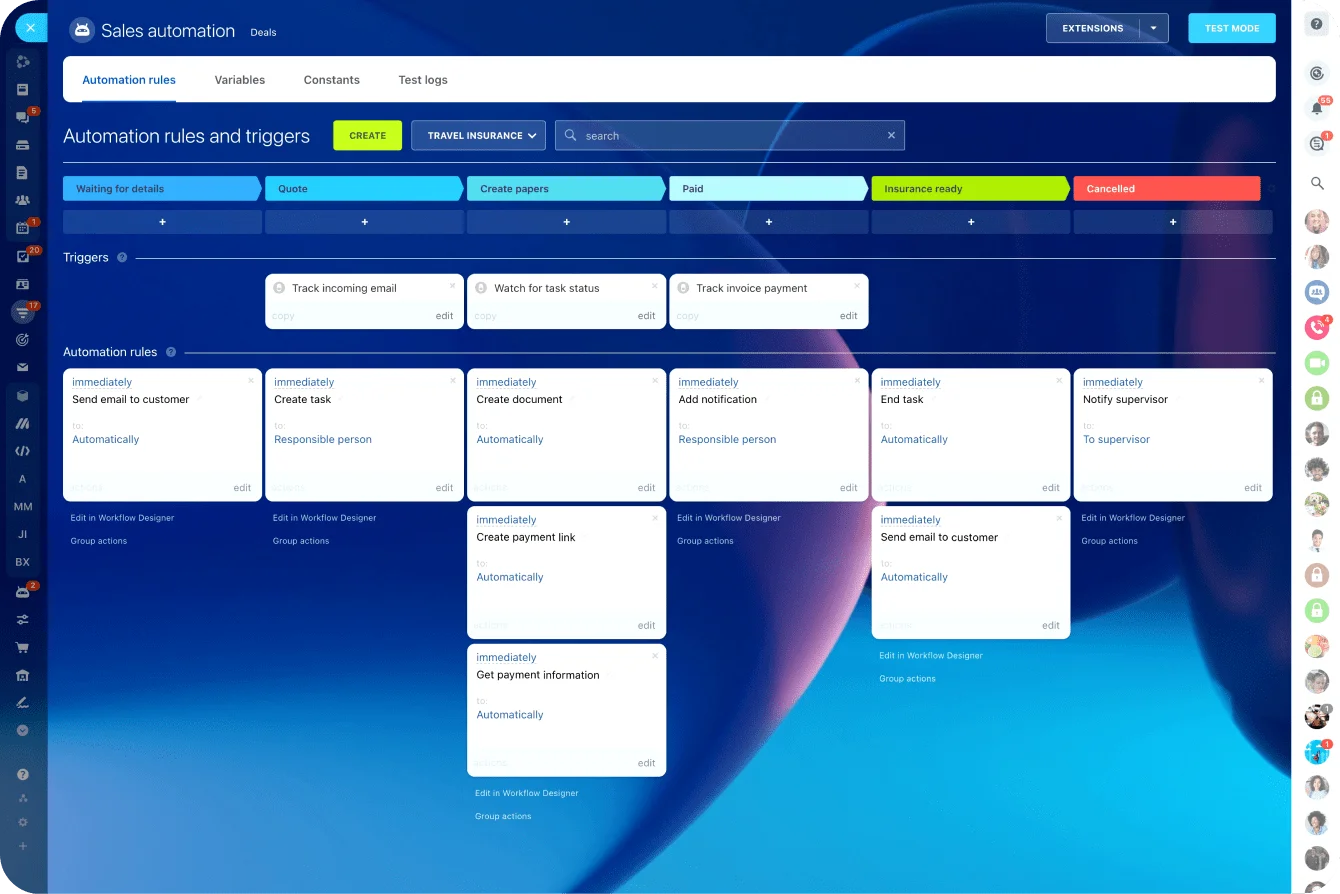
Task automation earns its place when it reduces the time between signal and action. Task automation can handle the repetitive parts: auto-tagging users who stall at the same onboarding step, alerting when stage conversion drops below a threshold, routing churn-risk accounts into an intervention sequence, and pushing experiment results into a central repository at closeout.
Judgment still has to stay in the loop. A conversion alert should trigger a review, not an automatic redesign. A support theme flagged by an AI model should be validated before it enters the backlog. Lifecycle automation can route an account into a play, but a human should check whether the play fits the segment and contract value before it fires.
Keep one shared view
Visibility is what keeps the system from collapsing into one person's private spreadsheet. Everyone needs a shared view of stage performance, active experiments, blocked issues, and recent decisions.
If product changes onboarding logic without marketing seeing it, or lifecycle edits qualification messaging without sales context, the journey starts drifting again.
A shared view keeps the journey visible as one system instead of letting every team manage its own version of the truth.
Use control points that protect reliability
Control points stop speed from wrecking reliability:
- Metric definitions locked before anyone compares outcomes
- Named dashboard ownership, so broken reporting gets fixed fast
- Experiment approval criteria based on expected impact and design quality
- QA checks before launch for routing, tracking, and customer-facing content
- Holdout or comparison rules wherever controlled testing is possible
- Rollback triggers if a downstream metric degrades
- An audit trail of what changed, when, by whom, and why
Skip these and teams move faster at first, then lose the next month arguing about whether the results were even real.
Common failure points in iterative journey improvement
Diagnosis mistakes
The most common mistake is changing too many variables at once. A team rewrites the ads, reworks the landing page, alters the signup flow, and launches a new onboarding sequence in the same two-week window. When the numbers move, no one can say which change caused it. The work feels productive, but the learning is worthless.
Another mistake is optimizing one stage in isolation. It is easy to lift lead volume by loosening qualification or widening targeting. But if those leads activate poorly and churn faster, the funnel did not improve. The waste just moved downstream where it is harder to see.
Teams also over-diagnose messaging. Sometimes a drop-off is not a copy problem at all. It can be routing latency, weak fit, a missing product capability, bad timing, pricing confusion, an approval step, or an onboarding dependency nobody surfaced earlier.
Discipline and measurement gaps
Process discipline tends to slip in smaller ways:
- No minimum evidence threshold before opening a test
- No explicit success metric for the stage being improved
- No implementation owner once a test "wins"
- No taxonomy for customer feedback, so patterns stay anecdotal
Measurement is its own trap. Teams read too much into small samples, compare cohorts with different attribution windows, or define stages so loosely that users slide between buckets.
They also call success too early. A click, form fill, or signup may look positive in isolation, but the next real milestone matters more: first value reached, opportunity accepted, account retained, or expansion achieved.
Stack enough weak success signals together and the organization gets busier without getting smarter.
How to scale the process for reliability, speed, and compounding ROI
Scaling starts when the work stops being a string of custom one-offs. Mature teams build standard playbooks for recurring problems: low trial activation, slow sales follow-up, poor onboarding completion, weak expansion, and rising churn in a specific segment.
Each playbook should name the known signals, likely root causes, default owners, preferred test options, and measurement rules.
Reusable templates help too. A standard experiment brief, a common intake format for new issues, and a consistent readout structure cut the time spent re-litigating process.
Rank the backlog by business impact
As the backlog grows, teams need a ranking model that goes beyond what feels urgent. A practical model usually weighs:
- Estimated revenue or retention impact
- Confidence in the diagnosis
- Implementation effort
- Cross-functional dependency load
- Time to learn
That comparison matters because every stage can produce convincing problems. The goal is not to fix everything in order of noise. It is to choose the work most likely to improve the total journey.
Adapt the journey by segment
In larger organizations, scaling also means admitting that one journey will not fit every motion. Enterprise, SMB, partner-led, and self-serve each may need their own stage logic and cadence. A self-serve motion tracking activation through a sales pipeline view runs on a very different rhythm than an enterprise motion with a six-month sales cycle.
Local teams can own regional or product-line execution, while a central group governs metric definitions, taxonomy, tooling standards, and portfolio review.
Set a cadence that matches the motion
A tiered cadence works well. High-volume stages get a weekly look. Lower-volume or strategic tracks run monthly. Portfolio review happens quarterly to balance quick wins against deeper changes that need product, data, or process redesign.
Reliability is what turns activity into compounding return. Use instrumentation audits to catch tracking drift, backlog aging reviews to stop important issues vanishing into limbo, recurring synthesis to connect quantitative and qualitative patterns, and learning transfer so a win in one segment, region, or product line can be tested elsewhere.
The return comes from the system that turns every validated improvement into a reusable asset, not from any single brilliant experiment.
Make every stage improve the next
Funnel leaks rarely stay contained. A weak handoff, slow routing rule, unclear onboarding step, or repeated support blocker may appear in one stage, but the cost usually shows up somewhere else.
Iterative journey improvement keeps those issues visible, owned, and moving.
The aim is to establish a practical rhythm for finding friction, fixing what matters, and turning each validated improvement into a stronger handoff, clearer automation, or better playbook.
That is how gains start to compound. Each fix makes the next stage easier to manage, measure, and improve.
Bitrix24 brings CRM, marketing, sales, tasks, automation, reporting, contact center tools, and team collaboration into one connected workspace, so the journey is easier to manage as a system rather than a set of disconnected fixes.
Build your next improvement loop in Bitrix24 and make every stage work better with the one after it.
Unify every funnel stage in Bitrix24
Connect CRM, automation, tasks, reporting, and collaboration to spot friction, assign owners, and improve each handoff.
Get Started NowFAQ
How often should teams review and reprioritize journey issues?
Weekly is usually right for active backlog review in faster-moving funnel stages. Monthly can work for lower-volume motions. Reprioritize often enough to reflect current evidence, but not so often that teams keep resetting work already in motion.
What should happen when a friction point spans marketing, product, and support at once?
Assign one accountable owner for the issue, even if several teams contribute to the fix. Build a shared problem statement, separate immediate mitigation from structural remediation, and escalate early if dependencies block action.
When is a full redesign justified instead of iterative fixes?
When repeated improvements fail because the stage logic itself is broken. Examples include a fundamentally wrong onboarding sequence, qualification model, pricing path, or product setup flow. If local fixes keep treating symptoms, redesign the stage architecture rather than stacking more patches on top.
What if volume is too low for statistically strong tests?
Use stronger pre-test diagnosis, narrower scope, and milestone-based evidence. In low-volume environments, combine directional quantitative data with structured qualitative input and compare against downstream business outcomes over longer windows. Don't force fake precision.
How do you run journey improvement with limited engineering support?
Prioritize changes that use existing systems first: routing rules, lifecycle messaging, qualification logic, support interventions, CRM workflows, in-app copy, and onboarding operations. Reserve engineering time for high-impact structural fixes, and package requests with clear evidence so they compete better in backlog planning.
Which metrics should govern decisions when acquisition and retention teams disagree?
Use the metric that best reflects the business objective at the stage boundary in question. If acquisition gains are causing downstream churn, retention-adjusted conversion or payback quality should override top-of-funnel volume. The system shouldn't reward local gains that damage total funnel performance.
Who should own the journey backlog in a multi-product company?
A central growth, lifecycle, or RevOps function can own the operating framework, but each product line should have a designated journey owner responsible for prioritization and execution within its motion. Shared governance, local accountability.
How do you operationalize qualitative feedback at scale?
Create a fixed taxonomy for objections, friction types, feature gaps, onboarding blockers, and support themes. Tag feedback consistently in CRM, support, and success tools, then review coded patterns alongside conversion data. Raw comments alone don't scale.
What should be automated first if the current process is mostly manual?
Start with signal collection and routing: stage alerts, issue intake, tagged feedback capture, handoff notifications, and backlog status visibility. Those automations cut delay and coordination loss without removing the human judgment needed for prioritization and decisions.