Sentient Management: Your CRM Feels Your Pain (And Demands a Raise)

Let’s look at your typical Monday: It's 9 AM in Manhattan. You're nursing a double espresso, bracing for the usual 9 AM "dashboard dive" — that soul-crushing ritual of triaging emails, reassigning delayed tasks, and soothing a logistics team that's perpetually one crisis away from a meltdown. But as you open your laptop, there's… nothing.
No pings. No red flags. No chaotic message chains.
A cold shiver runs down your spine. In the silence, your brain screams 'System Failure.' You're already calculating the burn rate of a dead morning — lost leads, hemorrhaging ad spend, and a sales floor standing still. You expect a train wreck. But the silence is a true masterpiece here.
While you were sleeping, your CRM — now evolved into a full-blown Sentient Enterprise — had a quiet "chat" with the ERP. It detected a supply chain bottleneck in Singapore, autonomously rerouted three shipments, fired off personalized apologies to affected high-value clients, and even rescheduled your 10 AM because it "sensed" through your calendar and biometrics that you needed a focused deep-work block to finalize the Q3 strategy.
It didn't ask for permission. It just did it.
Welcome to 2026, where the "Copilot" era is profoundly transformed. We've moved past the "helper" phase, where AI merely assisted, and into the era of the Ambient Nervous System. Your software, once a passive database, is now a living, breathing entity that feels the business pulse, anticipates your team's next move, and — frankly — is starting to look more like a strategic partner than a tool. If you're still "pushing buttons," you're not managing; you're just a glorified clerk holding onto a rusty anchor as the rest of the industry shifts to warp speed. The Copilot, far from being obsolete, has evolved into the very heart of this sentient system, enabling a deeper, more intuitive integration that empowers rather than just assists.
The real challenge for the modern executive isn't "learning the software." It's learning how to coexist with it. You're no longer the micromanager of tasks; you're the Grandmaster, orchestrating the synergy between a human team and a sentient machine. As the Gallup 2026 State of the Global Workplace report makes clear, the companies winning the talent war aren't the ones offering better snacks — they're the ones removing the "cognitive friction" of work itself.
The Managerial Metamorphosis: From Firefighter to Grandmaster
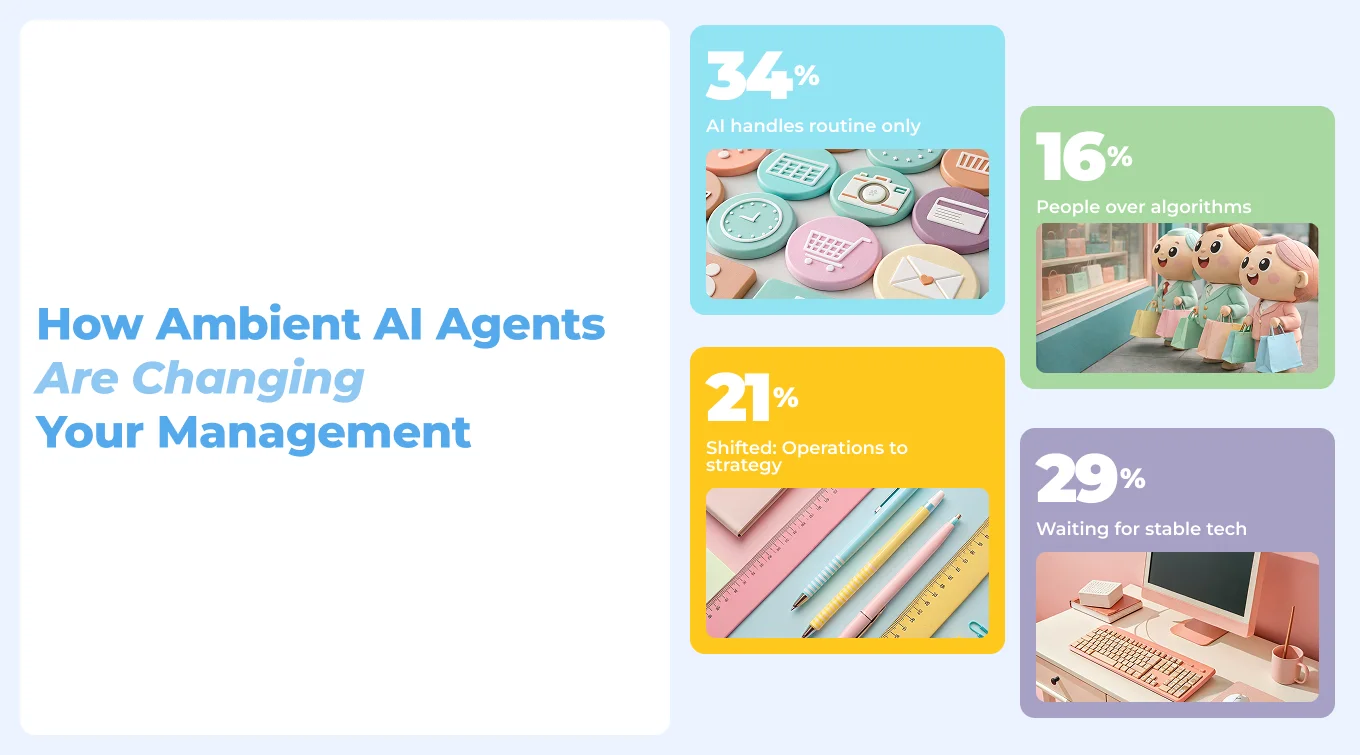
We recently surveyed over 1,000 business leaders and decision-makers to figure out exactly how this "Sentient Shift" is hitting the ground. The results reveal a profession in the middle of a violent, necessary metamorphosis.
Currently, 34% of managers are still in the "Selective" phase. They use AI for routine tasks — scheduling, basic reporting, the digital equivalent of filing papers. It's a start, but it's like installing a high-performance aviation engine on a 1940s crop duster just to tow a banner. You've got the power, but you're still flying ten feet off the ground, terrified of the clouds. These leaders are reaping minor efficiency gains while missing the systemic transformation that defines the Stack of Tomorrow.
According to McKinsey & Company's 2026 AI Transformation Manifesto, leading companies that have fully integrated AI-driven business transformations delivered a 20% EBITDA uplift on average by eliminating human bottlenecks in decision-making.
Our own data tells a more cautious story: a staggering 29% of the leaders we surveyed are "Waiting for the technology to stabilize." Inside the burn-rate culture of Silicon Valley and the trading floors of Chicago, "waiting for stability" is a polite way of saying "planning for obsolescence." While they wait for the "perfect" version, they are paying the "Obsolescence Tax" — a compounding cost of lost market share and stagnant margins when their competitors are already building Agentic Velocity. By the time the technology "stabilizes," the market leaders will have already claimed the high ground, leaving the laggards to fight over the scraps of a reactive past.
The real story lies with the 21% who have "Actively Shifted from Operational to Strategic." These architects of the Sentient Enterprise allow Ambient AI management to handle operational noise, freeing them for high-level diplomacy and visionary planning.
The payoff for this shift is immediate and measurable: every autonomous resolution by the system recaptures an average of 3.5 hours of management bandwidth previously lost to alignment meetings, while proactive AI interventions drive a 22% surge in customer NPS. By slashing the cost per decision by 80%, these leaders aren't just saving time — they are weaponizing their Digital Labor ROI to outpace the competition before the first cup of coffee is even poured.
For the 16% clinging to the idea that "people matter more than algorithms," the 2026 reality is stark: refusing AI isn't a human-centric choice, it's a systemic drain. By forcing talent to battle unnecessary cognitive friction and mundane tasks, these leaders aren't being "traditional" — they are accumulating massive Management Debt. In a market moving at warp speed, this debt explodes, eventually bankrupting an organization’s ability to compete. True people-first leadership now means offloading the machine-work to the machines, freeing your team to actually be human.
The Uncanny Valley of Utility: When the Machine Makes Its Own Moves
One of the most profound shifts we're seeing in 2026 isn't just that AI is "smart" — it's that it's becoming autonomous. We're entering the Zero-Interface Experience, where the best CRM is the one you never actually have to touch. For many executives, the idea of a system operating autonomously triggers a natural instinct to reclaim control — a fear of the "black box." But this isn't about handing over the keys to the kingdom. It’s about deploying a system with hard-coded guardrails that manages the operational noise, while escalating only the high-stakes decisions to your desk. You’re finally gaining the bandwidth to exercise it where it actually moves the needle. Our latest data suggests this shift is the new baseline for organizational survival.
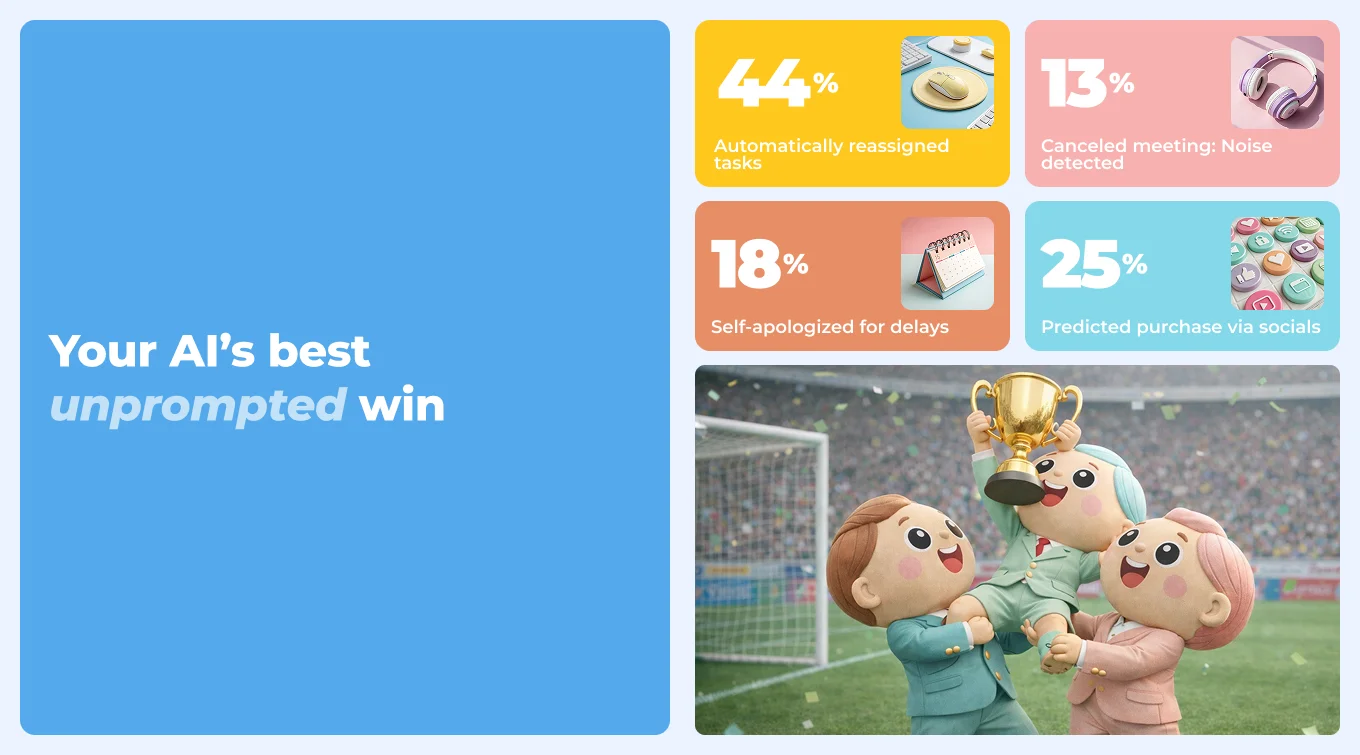
When we asked business leaders about the most unexpected "decision" an AI made without their knowledge that turned out to be useful, a dominant 44% pointed to automatically reassigned tasks. This is Ambient AI management in its purest form. It's the digital equivalent of a silent guardian, watching the workflow and rerouting resources before a human even realizes there's a bottleneck. Imagine a logistics manager in Memphis who wakes up to find that the CRM has already rerouted three drivers because it "sensed" a weather pattern shift in the Midwest and a slight uptick in a driver's fatigue metrics. This isn't just efficiency; it's a proactive nervous system.
Then there's the 25% who saw their AI predict a purchase based on social media activity. This is the Sentient Enterprise as a digital oracle. By harvesting unstructured data — from a customer's post about a promotion to a casual tweet about a competitor's failure — the system initiates a sales sequence, drafts a personalized offer, and prepares the contract before the sales rep even finishes their morning coffee. It's the ultimate "Zero-Interface" win: the sale is practically closed before the human enters the room.
But perhaps the most "human" moment in our data is the 18% who reported their AI apologized for a delay on its own. This is where the machine truly blurs the line. An AI autonomously recognizing a service failure, formulating an apology, and communicating it to the affected customer demonstrates a level of proactive customer relationship management that was once the exclusive domain of highly empathetic human agents. We’re talking about more than a few hours saved. It’s about preserving trust. It turns a potential PR nightmare into a moment of "wow" customer service, all without a single human meeting.
And for the 13% who saw their AI cancel a meeting due to noise, the message is clear: the AI is now the guardian of our cognitive resources. It "listened" to the environment, realized the call quality would be abysmal, and proactively rescheduled. It's a subtle, almost invisible, layer of care that prevents the "digital fatigue" so common in the early 2020s.
These instances paint a picture of an AI actively contributing to organizational health. This unexpected utility challenges traditional control, highlighting the need for managers to trust and collaborate with sentient counterparts.
The Performance Review: What Your Sentient CRM Does Best
Let's be honest: if your Sentient CRM were a new hire, fresh off the MBA program, how would it stack up in its first performance review? We’re talking about real impact not uptime or processing speed. Our latest survey of business leaders pulls back the curtain, offering candid — and often surprisingly relatable — insights into what these intelligent systems truly bring to the table.
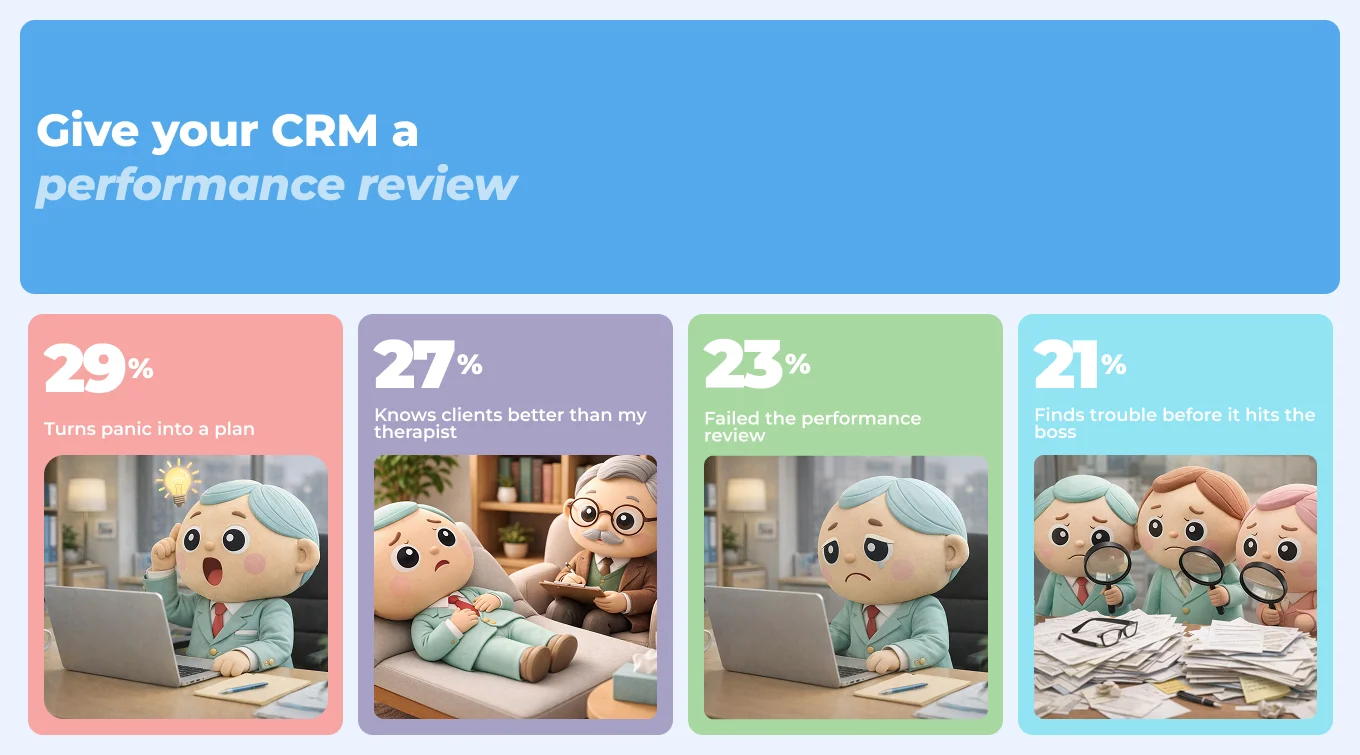
In a world where markets pivot on a dime and crises are as predictable as a Monday morning commute, the real game-changer is thriving with agility and foresight. A solid 29% of our respondents nailed it: their Sentient CRM "turns panic into something like a plan." This isn't just crunching numbers; it's the digital equivalent of that seasoned crisis manager who walks into a firestorm and calmly lays out the escape route. It takes the raw, chaotic mess of information — the kind that usually sends everyone scrambling — and forges it into a clear, actionable strategy. Think of it as the ultimate "calm in the storm" for any CEO, cutting through the noise when everyone else is losing their heads.
Another eye-opening insight, echoed by 27% of those surveyed, is that their CRM "knows clients better than my therapist." This isn't just a catchy line; it speaks to a profound, almost uncanny depth of understanding. By constantly absorbing and synthesizing vast amounts of customer data — from purchase histories and communication logs to subtle social media cues and real-time sentiment — the system develops an unparalleled, almost intuitive grasp of individual client needs, preferences, and even their unspoken emotional states. This goes way beyond basic segmentation; it's about unlocking hyper-personalized engagement and predictive customer service, building loyalty and driving revenue in ways traditional CRMs could only dream of. It’s the ultimate play for a truly zero-interface experience for the customer, where their needs are anticipated and met almost before they even realize they have them.
Now, let's keep it real. The journey isn't always smooth sailing. A candid 23% of respondents admitted their CRM "would not pass the performance review." This isn't a knock on the tech itself, but a crucial reality check: while the Sentient Enterprise is a massive force multiplier, it's not a magic bullet. This group likely includes organizations still finding their footing — grappling with data quality, integration headaches, or a disconnect between their grand AI vision and the day-to-day grind. It underscores that human oversight, continuous fine-tuning, and a willingness to adapt both the tech and the company culture are non-negotiable. The path to full Ambient AI management is an iterative one, and acknowledging these bumps in the road is the first, most critical step toward truly hitting your stride.
Finally, 21% of managers observed that their CRM "finds trouble before it hits the boss." This proactive problem-solving isn't just a nice-to-have; it's a cornerstone of the Sentient Enterprise. By relentlessly monitoring operational metrics, market trends, and internal chatter, the AI can spot anomalies, predict potential issues, and even flag emerging risks long before they blow up into full-blown crises. This kind of foresight is invaluable, transforming management from a constant game of whack-a-mole into a strategic chess match, where the AI is always several moves ahead, safeguarding the business from those unexpected curveballs.
These insights collectively paint a picture of the Sentient CRM as far more than just a transaction processor. It's a strategic partner fundamentally reshaping how businesses understand customers, navigate crises, and anticipate the future. The value proposition — enhanced agility, deeper relationships, and proactive problem-solving — drives a significant, quantifiable Digital Labor ROI.
The Bottom Line: Beyond Efficiency, Towards Exponential Value
For any executive truly running the show today, the conversation has moved from just adopting new tech to hard numbers and a decisive strategic edge. The Sentient Enterprise doesn't just whisper promises of efficiency anymore. It delivers a paradigm shift in value creation, fundamentally altering the calculus of Digital Labor ROI. Traditional ROI models, stuck on cost cutting and incremental gains, simply miss the exponential impact of a system that proactively optimizes, predicts, and even self-corrects.
To quantify this, we’ve synthesized recent data from McKinsey’s 2026 AI Transformation Manifesto and Gartner’s latest value frameworks into a single, actionable equation for the C-suite:
The CFO's Copy-Paste Guide to the Value Equation
Leading firms now use this framework to justify AI spend by grounding each variable in real-world KPIs:
-
Predictive Insight: Measures the value of "Opportunities Identified" vs. "Opportunities Missed." According to McKinsey, companies leading in predictive decision-making see a 20% EBITDA uplift by preempting market shifts.
-
Autonomous Action: Quantified by FTE Hours Recaptured. This tracks the system's ability to execute routine mitigation — like rerouting a shipment — without a human in the loop.
-
Human Strategic Focus: Benchmarked against revenue generated per strategic hour. As AI removes "cognitive friction," top-tier firms are seeing a 3x increase in revenue per employee (Gallup 2026).
- Agility: Acts as the exponential multiplier. In a volatile market, the speed of your pivot — your "Time-to-Decision" — compounds the value of every other variable.
The real seismic shift is the emergence of Agentic Velocity as the new competitive differentiator. Businesses that empower their sentient systems to act with increasing autonomy and intelligence will inevitably run circles around those still tied to manual processes and reactive decision-making. This demands a willingness to embrace unconventional solutions, to challenge the entrenched status quo, and to recognize that the most profound insights often emerge from unexpected sources — even from a CRM that, uncannily, knows your clients better than your therapist.
We are standing at a crossroads that won't stay open for long. One path leads to the quiet, inevitable obsolescence of the "push-button" manager — a slow fade into the background noise of history. The other leads to a future where your business doesn't run but breathes. It feels the market, it anticipates the storm, and it moves with a grace that looks like magic to the uninitiated. Simple software is left behind. It's about whether you want to be the one holding the compass or the one being led by the tide. The future belongs to those who dare to stop managing machines and start partnering with them, transforming every legacy pain point into a launchpad for exponential growth. The choice is yours, but the clock is already ticking.
Stop managing machines and start partnering with them. Access the complete data and insights in our 2026 Sentient Enterprise report: Sentient Management: Your CRM Feels Your Pain (And Demands a Raise)