Gantt Chart Alternatives


Your Gantt chart looked perfect Monday morning. By Thursday, one task has slipped two days, a priority shifted, and half the bars no longer reflect reality.
You're still managing the work, just not inside the system that was supposed to guide it.
That disconnect is why many teams quietly stop trusting their Gantt charts.
The eight alternatives below each solve a specific visibility problem — flow, priority, workload, or timing — that a single timeline can't handle on its own.
TL;DR: Gantt charts show how work was supposed to happen, not how it's actually moving. Kanban boards, task lists, calendars, workload views, timelines, mind maps, scrum boards, and hybrid setups each solve a specific visibility gap. The most effective teams layer multiple views rather than forcing everything into one structure.
|
Alternative |
Best for |
Main visibility problem solved |
When not to use it |
|---|---|---|---|
|
Kanban boards |
Agile teams, operations workflows, continuous delivery |
Shows where work is getting stuck in real time |
When fixed deadlines and dependency chains matter most |
|
Task lists |
High-volume work, shifting priorities, individual contributors |
Clarifies what needs to happen next |
When work must follow a strict sequence |
|
Calendar view |
Campaigns, scheduling, deadline-driven work |
Makes timing conflicts and stacked deadlines visible |
When dependencies are more important than dates |
|
Workload management |
Resource planning, multi-project teams |
Reveals capacity issues before they delay delivery |
When team capacity is not a major constraint |
|
Timeline view |
High-level planning, stakeholder updates |
Communicates phases, milestones, and progress simply |
When task-level dependency control is required |
|
Mind maps |
Brainstorming, early-stage planning, scope definition |
Helps structure ideas before committing to a plan |
When execution has already started and tasks are defined |
|
Scrum boards and sprints |
Product teams, agile environments, iterative delivery |
Supports short planning cycles and changing priorities |
When the project needs fixed long-term sequencing |
|
Hybrid views |
Growing teams, cross-functional work, complex projects |
Gives different teams the right view of the same work |
When a simple single-team workflow is enough |
Why teams are moving beyond Gantt charts
Gantt charts were built for structured, predictable work — construction projects or long programs where timelines are stable and dependencies don't shift mid-stream. Most modern teams don't operate that way. Priorities change based on new customer information, unplanned tasks appear weekly, and keeping the Gantt chart in sync with reality becomes, well, a job in itself!
The problem isn't the tool; it's the mismatch between the tool and the work. The Project Management Institute's Disciplined Agile research points to a telling pattern: teams most often abandon Gantt charts after watching them collapse under the weight of "too much detail that was better captured in different ways" — detail that demanded constant maintenance as the project evolved.
That doesn't mean Gantt charts are broken
They're miscast. As Marisa Browne, a PMP-certified project manager at Traffix, puts it, a Gantt chart earns its keep "when you are looking for a comprehensive reference for reporting on project progress," giving you timeline slippage, dependencies, critical path, and completion percentages across the full lifecycle in one view.
That's a reporting and communication job, not a daily execution one.
The eight alternatives below fill the gaps Gantt charts were never designed to cover. The best teams use them alongside Gantt rather than in place of it.
1. Kanban boards: visualize work in motion
Best for: Agile teams, operations workflows, continuous delivery
Instead of mapping work across time, Kanban shows how work moves through stages: To do → In progress → Review → Done. Bottlenecks become visible as they form, not after deadlines slip. Teams also see who's actively working on what, rather than who was scheduled to work on it three weeks ago.
Example: A content team pushing multiple campaigns. On a Gantt chart, everything looks "on track" because the bars haven't crossed their end dates yet. On a Kanban board, half the tasks are stuck in Review. That's the bottleneck, and you can act on it immediately by reassigning reviewers or reducing work-in-progress limits.
When to use Kanban:
- Work is ongoing rather than fixed
- Priorities shift frequently
- You need visibility into daily execution
- Work-in-progress limits matter more than completion dates
Project Timeline Decision Matrix + Tool Comparison Grid
Enter your email address to get a comprehensive, step-by-step guide

2. Task lists: fast, flexible prioritization
Best for: High-volume work, shifting priorities
Sometimes you just need a clear answer to one question: what needs to happen next? Task lists focus on priority, ownership, and deadlines without the overhead of timelines and dependencies. They're the simplest view in the kit, which is exactly why they scale well for individual contributors and small teams handling constant inbound work.
Example: An operations team handling incoming support escalations, internal IT requests, and ad hoc leadership asks doesn't follow a fixed sequence. Work arrives throughout the day. A Gantt chart would be outdated within hours; a list re-sorts in seconds and keeps the daily focus clear.
When to use task lists:
- Managing high task volume
- Work doesn't follow a strict sequence
- Priorities change throughout the day
- Team members need to manage their own queue
3. Calendar view: simplify time-based planning
Best for: Campaigns, scheduling, deadline-driven work
Calendar views show tasks exactly where they matter — on specific days — making it easier to spot stacked deadlines, conflicts, or slow weeks. For a marketing team coordinating content drops, email sends, ad launches, and webinar dates, a calendar surfaces timing conflicts that a Gantt chart would bury under dependency lines.
Calendar views also make it easier for non-PMs to stay aligned. Executives, clients, and cross-functional collaborators understand a calendar instantly; Gantt notation takes more context to read.
When to use calendar view:
- Work is driven by deadlines, events, or launches
- You need a clear short-term schedule
- Cross-team coordination depends on timing
- Non-PMs need to read the schedule directly

4. Workload management: see capacity before it becomes a problem
Best for: Resource planning, multi-project teams
On a Gantt chart, two team members can look "allocated" — one drowning in three high-effort tasks, another with a single low-priority item. Workload views make the imbalance visible immediately, so you can rebalance before delays happen and before the overloaded person burns out.
Research from the APM (Association for Project Management) confirms the structural limit: Gantt charts "cannot easily cope with change as a result of progress or scope change" — which is why capacity problems stay hidden until they become delivery problems.
Workload views close that gap by showing real-time allocation across people, not just across time.
When to use workload management:
- Managing multiple projects simultaneously
- Team capacity directly impacts delivery speed
- You need proactive resource visibility
- Cross-project assignments are common
5. Timeline view: keep planning simple and usable
Best for: High-level planning, stakeholder updates
A timeline view gives a visual overview of phases and milestones without forcing you to manage every dependency. When presenting to stakeholders, they don't need every task relationship; they need to understand what stage you're in, what's coming next, and whether anything is at risk.
The difference between Gantt and timeline is control versus clarity. Gantt aims for precision; timeline prioritizes communication. For quarterly reviews, investor updates, and cross-department briefings, clarity wins.
When to use timeline view:
- You need a high-level overview rather than task-level control
- Stakeholders want simple, clear updates
- Dependency tracking isn't critical
- Communication matters more than precision
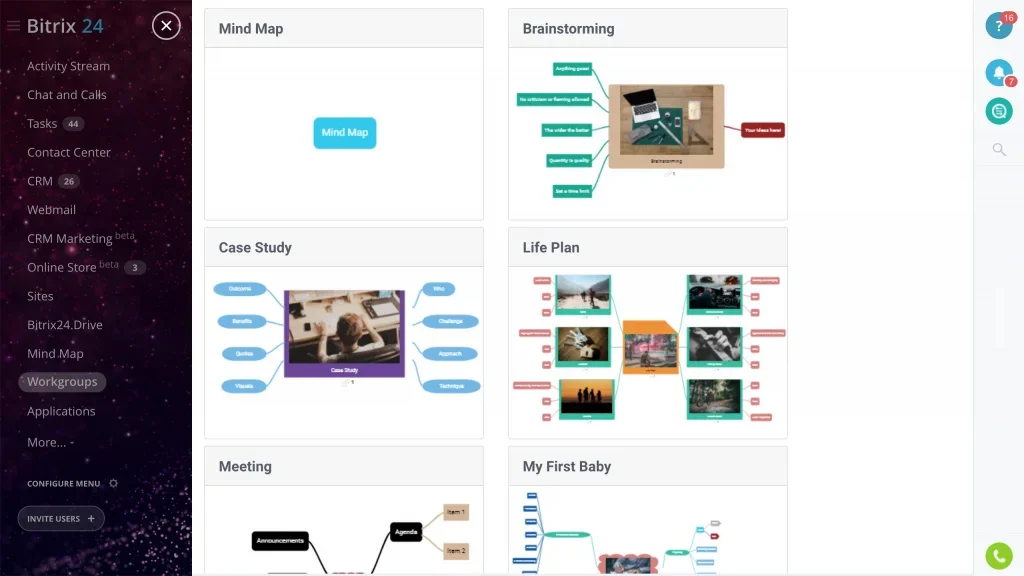
6. Mind maps: structure work before committing to a plan
Best for: Brainstorming, early-stage planning, scope definition
Before you build a timeline, you need to understand the work. Mind maps help organize ideas first — a central goal branches into tasks, sub-tasks, and themes. You can identify gaps before anything is scheduled, and surface dependencies conceptually before the Gantt chart locks them into specific dates.
Example: Planning a product launch, you might map out marketing, operations, sales enablement, and logistics as branches. Each expands into specific activities, revealing gaps — like a missing customer support training step — that a linear timeline would never have prompted you to consider.
When to use mind maps:
- You're in the idea or planning phase
- Scope is still evolving
- Alignment is needed before execution begins
7. Scrum boards and sprints: structured flexibility
Best for: Product teams, agile environments, iterative delivery
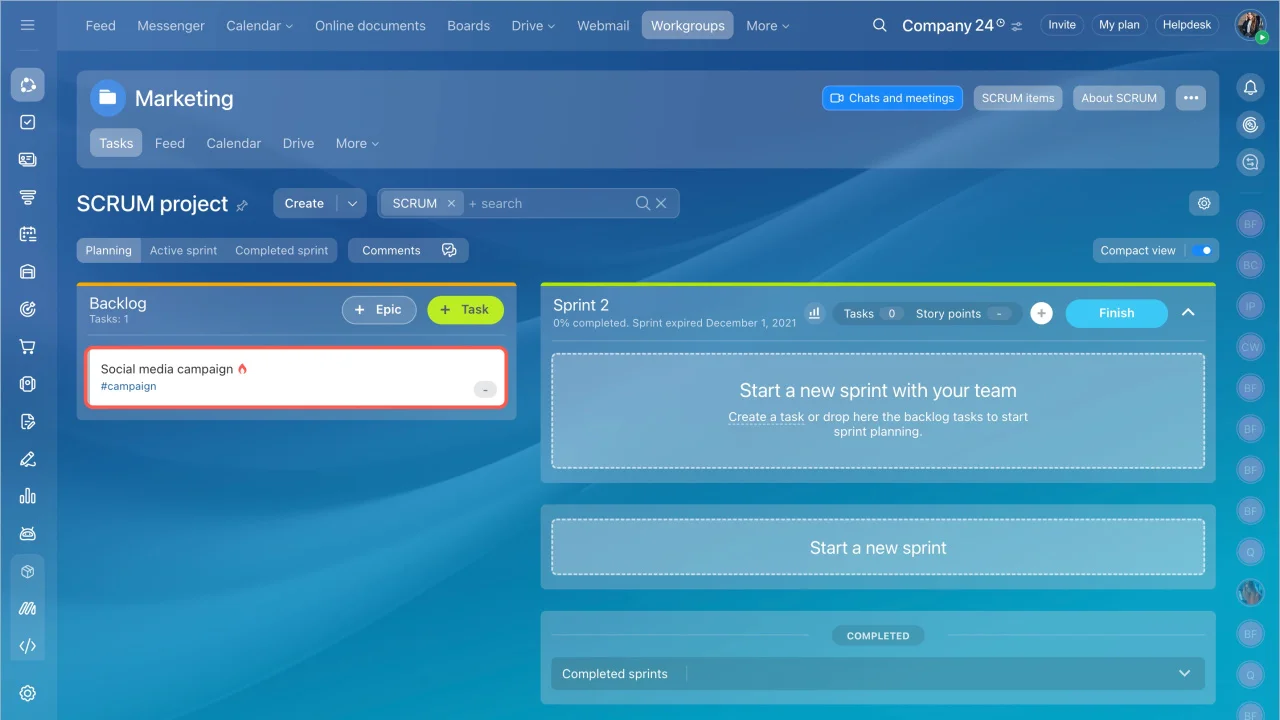
Instead of mapping everything upfront, work is broken into one- or two-week sprints with a defined backlog and board. A product team plans broadly for the quarter but only commits to a small set of tasks for the next sprint. If priorities shift, they adjust in the next cycle rather than rebuilding a months-long timeline.
This shortens the planning horizon to a realistic length. Gantt charts try to predict everything upfront; scrum accepts that plans will change and builds that acceptance into the process itself.
When to use Scrum:
- Work evolves quickly
- You deliver in iterations or releases
- Flexibility matters more than predictability
- Short feedback loops improve outcomes
8. Hybrid views: combine perspectives for full visibility
Best for: Growing teams, cross-functional work, complex projects
No single view represents how work actually happens. Hybrid setups let project managers work in timelines, developers work in Kanban, marketers work in calendars — all drawing from the same underlying tasks through workflow automation that keeps everything in sync without duplicate records.
This is where most mature teams land. Each role gets the view that matches their job without forcing anyone else into the same format. The result is context-specific visibility without data fragmentation.
When Gantt charts are still the right choice
Alternatives don't always beat Gantt charts. The question isn't whether Gantt is obsolete — it isn't — but whether it matches the work in front of you. Keep the Gantt when:
- You're running construction, manufacturing, or regulated delivery. Fixed dependencies, mandatory sequencing, and legal deadlines are exactly what Gantt charts were built for. The rigidity that frustrates agile teams is an asset here.
- Stakeholders specifically request a critical-path view. Investors, boards, and government clients often want the timeline format. Fighting that expectation wastes political capital you'll need for the decisions that actually matter.
- You're managing a fixed-scope, fixed-deadline project. When the endpoint and scope truly won't change, a Gantt chart's structure becomes predictive rather than aspirational.
- Your team needs dependency tracking for physical deliverables. Equipment arrivals, permit approvals, or vendor milestones benefit from the visual dependency chains Gantt provides.
- You're producing contractual documentation. Many client contracts, RFP responses, and compliance audits require Gantt-format timelines as artifacts. In those cases, the Gantt isn't a planning tool — it's a deliverable.
How to choose the right alternative
Start with the biggest constraint your team hits most often. The most common mistake is picking a view based on what looks impressive in a demo rather than what solves the actual friction your team experiences week to week. Match the view to the pain point:
- Work getting stuck → Kanban
- Constant priority changes → Task lists
- Deadline coordination → Calendar
- Team overload → Workload management
- Stakeholder reporting → Timeline
- Unclear scope → Mind maps
- Fast-moving product work → Scrum
- Multiple perspectives needed → Hybrid
Most teams don't replace Gantt charts entirely; they layer views on top.
The key is making sure those views aren't separate tools with separate data. A connected workspace keeps all perspectives drawing from the same underlying work, so switching views is just a click, not a migration.
Bitrix24 gives you Kanban, list, calendar, workload, and Gantt in one place. No duplicated tasks, no syncing overhead. Start for free and find the view your team actually works in.
Unlock efficient project tracking
Bitrix24 helps you shift from Gantt to Kanban, task lists, & other views with no data duplication. Enhance visibility & productivity in your workspace.
Try It FreeFrequently asked questions
How do I convince my manager to try alternative views?
Frame it as additive, not replacement. Keep the Gantt for reporting; add a Kanban board for daily execution. Show the bottlenecks it surfaces in the first two weeks.
What alternatives to Gantt charts does Bitrix24 offer?
Bitrix24 supports Kanban boards, task lists, calendars, workload views, Scrum-style sprint planning, deadline-based timelines, and classic Gantt charts — all drawing from the same underlying tasks so nothing gets duplicated.
Can teams switch between views without recreating tasks?
Yes. The same work can be viewed in different formats, which helps teams plan by deadline, workflow, or owner without duplicate records. Updates in one view instantly appear in the others.
When is a non-Gantt view the better choice?
Choose it when speed, changing priorities, and work-in-progress limits matter more than long dependency chains (or when daily execution visibility is more valuable than a static long-term schedule).
How do you know the new planning view is working?
Track cycle time, overdue rate, blocked tasks, workload balance, and the time it takes to move work from idea to completion. Compare month-over-month to see whether execution is actually improving.
How do I handle tasks that span multiple views without creating chaos?
Use tags, categories, or project labels so the same task appears correctly in every relevant view: assigned to an owner in a list, positioned in a Kanban column, and tied to a calendar deadline. One task, multiple valid perspectives. Avoid creating separate records per view.
AI readiness score: 47/50