Closing the Year: A Pipeline Review That Separates Real Deals From Hope


By December, a pipeline's problems aren't hidden. Everyone knows which deals have gone quiet. They stay in late stages because moving one back means saying so out loud, and nobody wants to go first.
The year-end review exists to make someone go first. Run it hard and this year's forecast loses its hope, and January stops opening on deals that already need explaining.
This article walks you through a review that holds every open deal to the same evidence test, moves the weak ones out of this year's number, and protects the deals that deserve to open January. You'll be able to run it in one meeting per team, then keep a lighter version going every month.
TL;DR (Quick Summary)
Year-end reviews fail when managers protect appearances instead of the forecast. This method makes every open deal earn its place in this year's number and in next year's opening pipeline, with one evidence test for every rep and every deal size.
- Set the purpose of the year-end pipeline review → Reset deal quality, and know when this format doesn't fit
- Pull the right deal set and agree the evidence standard → One population, one written test, records frozen before the meeting
- Test every open deal against three signals → Stage age against your own won deals, buyer-side activity, a buyer-confirmed next step
- Reclassify deals into clear year-end categories → Five categories, each with a forecast treatment and a reason code
- Remove false late-stage deals and preserve real carryover → Stage, amount and close date match what the buyer has done
- Run the review meeting with a scorecard and enforce reporting discipline → A clocked agenda, five measures and hygiene rules that shorten next month's review
Takeaway: A good review cuts hopeful revenue out of the forecast without damaging future pipeline. It leaves managers with cleaner numbers and a January they can actually plan against.
Set the purpose of the year-end pipeline review: forecast truthfully without damaging next quarter
The review has one job: separate revenue that deserves forecast confidence from deals still alive because nobody has challenged them. Left alone, it drifts. The question in the room shifts from "which deals show buying motion?" to "how much can we keep on the board?"
Agree three outputs before anyone opens the CRM:
- A realistic view of what can close this year
- A clean opening pipeline for next year
- A review standard managers can run again next quarter
Who runs it, and when
The sales manager owns each team's review and makes the final call on every category. The owner or finance lead joins for the rollup. They're the people who'll plan hiring and spend against the number, so they hear the verdicts first-hand.
The setup I'd use (timings are recommendations; adjust for team size):
- First full week of December, while buyers still answer email and there's time to act
- 48 hours beforehand for reps to update their records
- 60 to 90 minutes per team of six to eight reps
- Cross-team rollup within two working days of the last team review
Say early, and mean it, that moving a deal out of commit or out of the year is a normal outcome. Reps won't believe it otherwise. And the forecast has less slack than most leadership teams think: Gartner analysts report that only 7% of sales organizations achieve forecast accuracy of 90% or higher.
The failure is all too familiar. The pipeline stays padded for a mid-December board or bank meeting, January opens on deals nobody believes, and the cleanup happens anyway in March. By then the hiring plan has been signed off against a number that was never there.
When this review is the wrong tool
The format assumes a considered B2B sale with a few dozen open deals per team. Three situations call for something else:
- High-volume, short-cycle sales (deals closing within days): review stage conversion rates and lead response times instead of individual deals
- Renewal-heavy or recurring revenue: the question is churn risk, so review usage, contract end dates and account health
- One seller with a handful of deals: 30 minutes over a filtered list does the job, and the scorecard is overhead
For the solo seller, I'd still run the three signals on every deal. It's the meeting machinery that doesn't scale down.
30-Minute Deal Reality Scoring Sheet for Year-End Forecasts
Enter your email address to get a comprehensive, step-by-step guide

Pull the right deal set and agree the evidence standard before managers review anything
Reviewing the whole pipeline wastes the meeting. Pull two pools instead, one for this year's forecast and one for January's health:
- Every open deal with an expected close date on or before December 31, at any stage
- Every deal in your last two stages, whatever its close date
- Q1 deals above your average deal size (a recommended cut; draw the line wherever it captures the deals that shape next quarter)
- Any deal whose close date has moved at least twice this year
Those last two lines catch the deals hiding in plain sight: the late-stage deal parked on a comfortable February date, and the one that's been "closing next month" since summer.
Write the test down
Reviews fail at the definition level first. One manager reads a friendly reply as momentum. Another treats a proposal in circulation as a near close. A third keeps a deal in forecast because the rep "has a good feeling," and from there the rollup is politics.
Every manager reviews against the same written fields:
|
Field |
Counts as evidence |
Doesn't count |
|---|---|---|
|
Stage |
Matches the last thing the buyer did |
Matches where the rep expects the deal to be |
|
Days in stage |
Measured from the date the deal entered the stage |
A stage re-saved to reset the clock |
|
Last meaningful interaction |
Two-way contact the buyer took part in |
Outbound emails, automated sequences, voicemails |
|
Decision process |
Named decision-maker and known steps to signature |
"They're deciding in the new year" |
|
Commercial fit |
Budget or price range discussed with the buyer |
The rep's estimate of what they could pay |
|
Next step |
Buyer-confirmed, dated, tied to the buying process |
"Follow up next week" |
If your team already qualifies with MEDDICC (metrics, economic buyer, decision criteria, decision process, identify pain, champion, competition), its decision-process and economic-buyer elements map straight onto these fields. If it doesn't, December is the wrong month to introduce it. Reps will fill in seven new boxes to survive the meeting, and you'll end up reviewing their typing.
Buyer replies mislead too. "Let's reconnect later" keeps a relationship warm and justifies no forecast weight at all. The test I'd hold every record to: would an outside observer see buyer movement, or only seller persistence?
Prepare the list before the meeting
Sales ops or the manager pulls the list on Monday. Reps update by Wednesday. Freeze records 24 hours before the meeting, and review anything not updated as-is.
Skip the freeze and the first hour goes to live data entry, reps fixing close dates on screen while eight people wait. The deals that most needed scrutiny get two minutes each at the end.
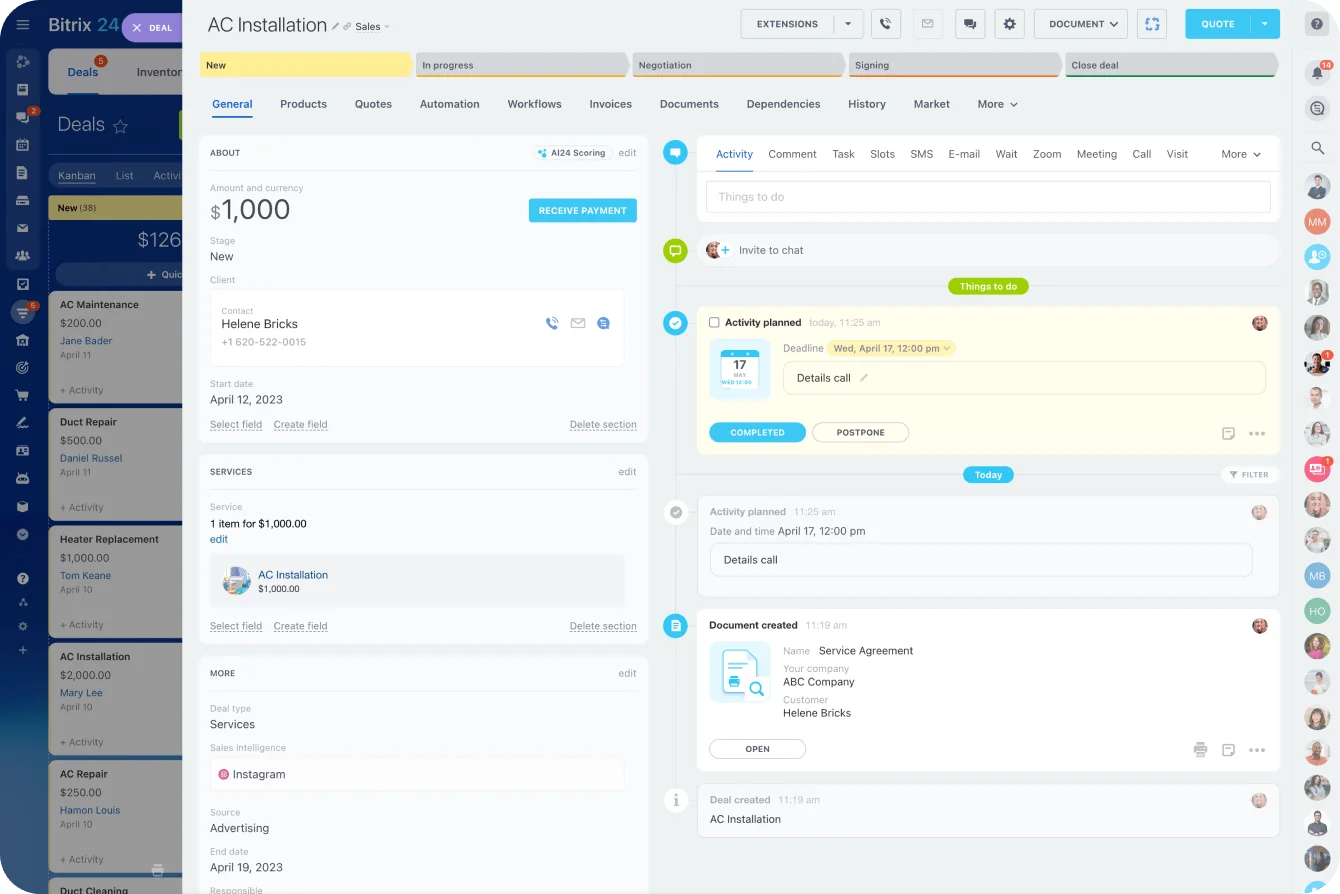
Bitrix24's sales pipeline management lets managers filter by owner, amount range and close-date window and save the view, so every manager reviews the same population. Required fields can be set by stage, which stops a deal moving forward with the evidence fields empty.
Test every open deal against three signals: time in stage, recent customer activity, and a confirmed next step
Any one signal can be explained away. All three together tell you whether the buyer is still moving.
Time in stage: set the threshold from your own won deals
Flag any deal that has spent more than 1.5 times the median days-in-stage of deals you won from that stage in the last 12 months. The multiplier is a starting recommendation. Tighten it once you see how many deals it flags.
Two details change the number:
- Use won deals only, because lost deals linger before they die and drag the median up
- Keep separate medians for separate motions (new business and expansion rarely move at the same speed)
Bitrix24's analytics and reports let you build reports on your own deal data, so the median comes from your history instead of a benchmark built on someone else's sale.
Recent customer activity: count what the buyer did
Message volume measures the rep. What counts is buyer behavior:
- Introducing a new stakeholder
- Discussing scope, terms or implementation dates
- Confirming procurement or legal steps
- Reacting to commercials, pushback on price included
As example targets, late-stage deals need buyer-side activity within the last 14 days and early-stage deals within 30. December bends this. If the buyer told you they're closed from the 20th to early January, silence inside that window means nothing. Silence in the three weeks before it means a lot.
The deal that fools experienced managers is busy and stuck. Weekly calls, warm replies, a contact who loves the product. Every call is with the same person, and that person can't sign. That's a relationship, and the stage should say so.
Confirmed next step: the most revealing signal
The buyer confirmed it, it's part of their buying process, and it has a date. In the meeting, ask the rep to forward the calendar invite or the email where the buyer agreed. For late-stage deals, also keep the date within the next 14 days. "Send reminder" and "check in after holidays" are the rep's plans, and the buyer hasn't signed up to either.
How the signals combine
A long stage is survivable when activity is current and the next milestone is fixed. The rule managers apply without debate:
- All three strong: the deal keeps its category
- One weak: it stays, with a dated fix for that signal assigned to the rep
- Two weak: out of commit, best case at most
- All three weak: out of the near-term forecast
An illustrative worked example. Won deals on your team spend a median of 20 days in proposal, so the flag sits at 30 (20 × 1.5). This deal has been in proposal for 45.
The last substantive buyer action, a pricing question, came three weeks ago, outside the 14-day late-stage window. The next step is the rep's own "check-in Monday." All three signals are weak, which marks a postponed decision, so the deal goes to nurture unless the buyer confirms a dated step this week.
A practical system for reviewing open CRM deals should make stage age, recent customer activity and buyer confirmation of the next step visible without an export. In Bitrix24, activity counters on each deal flag overdue follow-ups, and filters isolate deals with no activity scheduled.
Pro tip: Sort the review list by days since the last buyer-initiated contact. Last activity counts your own outreach, so a rep who emails every Tuesday keeps a dead deal looking current for months.

Reclassify deals into clear year-end categories instead of leaving them as generic open opportunities
"Open" tells finance nothing. After the test, every deal lands in a category that tells the business what to expect and the rep what to do next.
|
Category |
Evidence pattern |
Forecast treatment |
Immediate update |
|---|---|---|---|
|
Likely to close this year |
Current activity, normal stage age, buyer-confirmed milestone |
Commit |
Keep in forecast and tighten execution |
|
Possible but uncommitted |
Some motion, missing proof for confidence |
Best case |
Remove from commit, keep active follow-up |
|
Active for next year |
Real opportunity, timing shifted with evidence |
Next year's pipeline |
Adjust close date and Q1 plan |
|
Nurture/recycle |
Interest without an active buying process |
Out of forecast |
Move to nurture track with reason code |
|
Close lost or no decision |
No meaningful progress or buyer disengaged |
Closed |
Close the deal and capture the reason |
Four rules settle nearly every case:
- No buyer-confirmed next step: the deal leaves commit
- No meaningful activity and a close date that moves without stage progression: it leaves the near-term forecast
- An engaged buyer whose process runs into next year: active for next year, with no pretending December will fix the timing
- The biggest deals face exactly the same test as the smallest
The fourth rule is the one that slips. The deal that survives every review is the largest one, often an account the owner brought in personally. It sits in commit with a fresh date each quarter, and the biggest number in the forecast gets the least scrutiny.
UiPath learned this in front of analysts. In May 2024, the company said several large expansion deals had closed smaller or slipped out of the quarter, and co-founder Daniel Dines, who took the CEO job back that week, said it needed to "improve predictability on large multi-year deals." That's the fourth rule, learned after the miss.
Active for next year and nurture look identical in December
They split on one thing: a dated buyer-side event in Q1, such as a budget release or a board approval. If the rep can name the event and its date, the deal is active for next year. If the honest answer is "they said to come back after the new year," it's nurture, and it stays out of the opening pipeline.
Reason codes for everything that leaves the forecast
Every deal moved to nurture, no decision or lost gets one code from a fixed list. A starting set:
- No decision (buyer kept the status quo)
- Lost to a competitor
- No budget
- Champion left or lost influence
- Timing beyond next year
- Never properly qualified
Keep "no decision" apart from "lost." It's the bigger pile: research for The JOLT Effect by Matthew Dixon and Ted McKenna found that around half of lost deals, 40% to 60%, ended in no decision. Merge the two and you'll coach reps on competitive positioning when the real problem is buyers who never committed to anything...
Six codes is plenty. Any more and reps start picking "other." Bitrix24 can make a reason mandatory when a deal closes as lost, which is what keeps the codes usable for pattern review. Category, close date, amount and follow-up plan all change before the meeting ends, because "we'll clean up the CRM next week" means nobody will.
Pro tip: Have reps pre-classify their own deals into the five categories before the meeting, with one line of evidence each. The meeting then covers only the deals where the manager disagrees, and the size of that gap per rep is a coaching signal in its own right.
Remove false late-stage deals and preserve the opportunities that deserve next year's opening pipeline
Pipeline reviews go soft here. The team agrees a deal won't close this year, then leaves it in negotiation with a new date anyway. That deal is now contamination, and it carries straight into January.
The cost shows up in February. Deals that entered January in negotiation are still in negotiation with the same contacts, Q1 coverage looks healthy on paper, and reps spend the month defending old deals when they should be opening new ones.
A push into next year needs buying motion behind it:
- Procurement slipped, with a restart date the buyer confirmed
- A final stakeholder meeting is on the calendar
- Scope confirmation is underway and documented
Without one of those, the deal goes to nurture if the relationship is alive, or closes as no decision or lost if it isn't.
Stage, amount and close date must agree with the buyer
The rules I'd apply to every deal carried into January:
- Stage matches the buyer's last action, so a deal still in education doesn't enter January in final evaluation
- Unresolved scope means carrying the low end of the range discussed, never the full proposal value
- A close date pushed twice without stage movement needs manager sign-off and a written reason before a third push
- Probability resets to the stage default, whatever figure the rep entered
Tracking pushes takes one extra field: the original expected close date, never edited. Bitrix24 supports custom deal fields, so the push count sits on the record instead of buried in deal history.
One exception is real. Some buyers can't commit until new budget releases in Q1, so a December stall is sometimes genuine timing. It counts as carryover only if the buyer has confirmed the budget line and its release date.
The opening pipeline that survives all this comes out smaller. It's also the only version managers can plan hiring and marketing spend against.
Pro tip: Before moving a quiet late-stage deal to nurture, have the rep send a short "closing the file" email saying you'll stop following up unless timing has changed. Silent buyers answer that one surprisingly often, and the reply tells you which category the deal belongs in.
Run the review meeting with a manager scorecard and enforce the reporting discipline that makes it repeatable
Run the meeting to a clock
The manager chairs and decides. One person, usually sales ops or an admin, updates the CRM live. Reps speak only to their own disputed deals, and I wouldn't let them edit their own records in the room. Every edit turns into a negotiation.
An agenda for one team of six to eight reps (illustrative timings):
- 10 minutes: pre-classification totals and the scorecard before discussion
- 50 minutes: disputed deals only, largest first, signals before stories
- 15 minutes: the biggest Q1 carryover deals
- 10 minutes: confirm every category change is saved and every follow-up has an owner and a date
The scorecard
Track the same five measures for every team, every time:
|
Measure |
What it shows |
Red flag |
|---|---|---|
|
Deals reviewed |
Whether the whole population got tested |
Fewer deals reviewed than the list pulled |
|
Share of deals reclassified |
How much the review changed |
Close to zero, which usually means nobody challenged anything |
|
Amount removed from the current forecast |
The size of the correction |
A big removal from a team that reported a strong forecast a month ago |
|
Stale late-stage deals still open |
Manager leniency |
Any without a written reason |
|
Opening pipeline that passed the test |
January's real starting point |
Too little to cover the Q1 target |
When one team keeps far more stale late-stage deals than another, that's a management problem. And don't let a weighted pipeline total stand in for the review: a dead deal at 80% probability weighs exactly as much as a live one.
Hygiene rules that make the next review shorter
Most teams start from a low base. In Validity's 2025 survey of 602 CRM users and stakeholders, 76% said less than half of their organization's CRM data is accurate and complete.
Enforce these the day after the review, while the reasons are fresh:
- A dated next step on every active deal, logged from the mobile app before the rep leaves the client's office
- A reason code from the fixed list on every recycle, no-decision and lost outcome
- Written exit criteria for each stage, so reps can't advance deals on preference
- Notes that record customer evidence, with rep commentary left out
The notes rule is the one teams skip. "Good call, customer seems interested" is mood. "Customer confirmed legal review next week and named the procurement owner" is evidence.
Leave the reason code as free text and you'll pay for it a year later. You'll find "timing," "Timing," "timing - Q2" and "budget/timing" as four separate answers, and the pattern review you wanted costs a day of cleanup first.
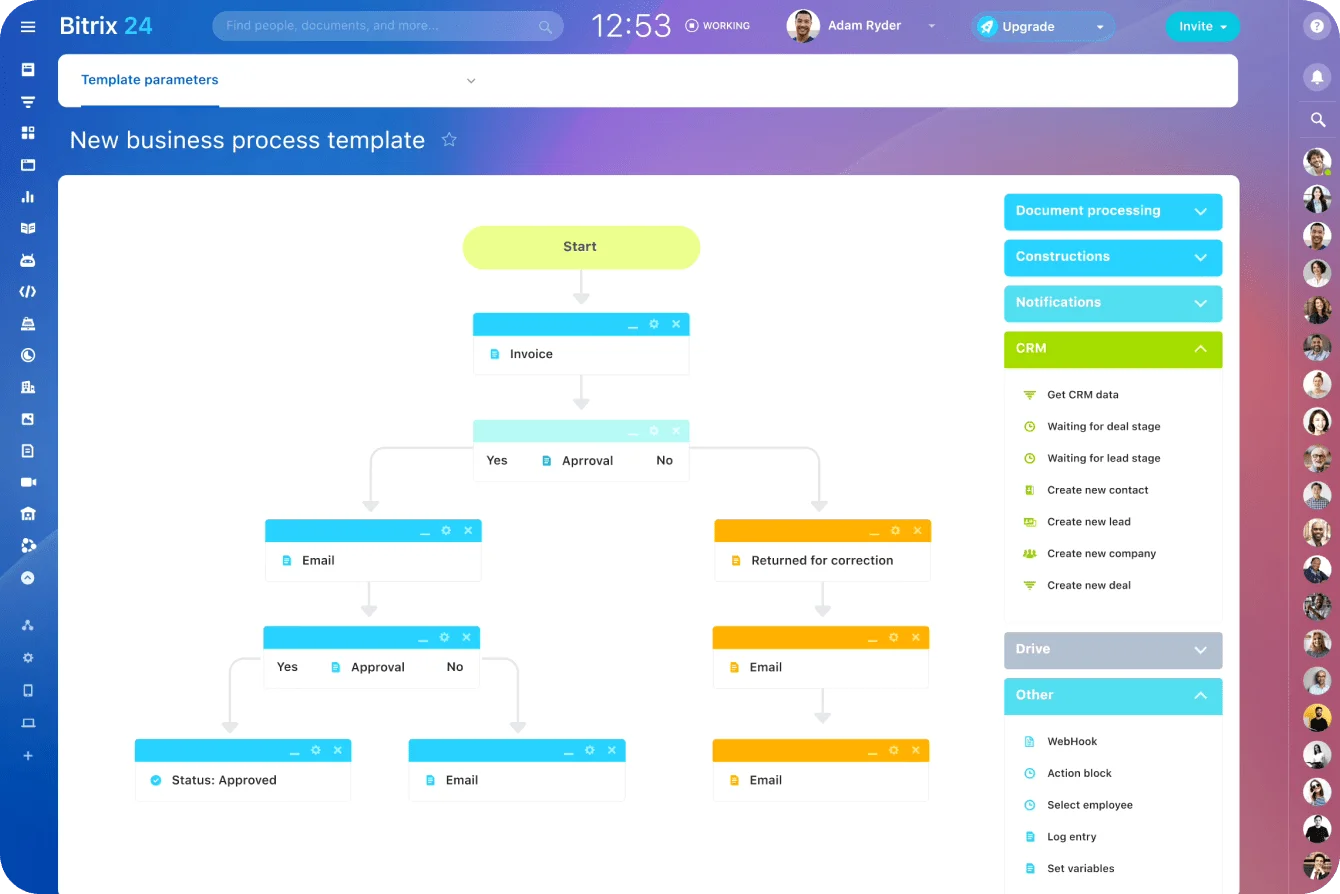
Automation takes memory out of it. With Bitrix24's task automation, a stage change creates the follow-up task with an owner and due date, so the next step exists before the rep moves on.
Keep a monthly version running
Run a 30-minute version every month on deals closing in the next 60 days (a recommended window), with the same scorecard and test. December then becomes the strict edition of a habit the team already has.
Three signs it's working:
- Fewer surprise slips in the last two weeks of a quarter
- Shorter forecast calls, because nobody argues about the standard
- A January pipeline nobody has to explain
FAQ
Where does a verbal yes with a January signature go?
It stays in likely to close only if the paper process is dated: the contract is with the buyer's legal team and they've given a return date. If signature waits on a budget release or approval that isn't scheduled, it's active for next year.
What if a rep disagrees with a reclassification?
Give them 24 hours to bring new buyer evidence that changes one of the three signals. A better story doesn't count. If the evidence holds, the manager restores the category and notes why.
Leadership wants pipeline coverage to look healthy. What then?
Show them coverage before the review and after it. Coverage built on deals that fail the test is a planning risk, and it's cheaper to replace in December than to discover in March.
Clean up forecasts before January planning
Use Bitrix24 CRM to review pipeline evidence, automate follow-ups, track deal stages, and start the year with cleaner forecasts.
Get Started NowForecast what the buyer has done
The review’s best output arrives after the meeting. Read the reason codes on everything that left the forecast and you’ll find two culprits: one stage with exit criteria too loose to mean anything, and one rep habit that kept dead deals looking current. Fix both before Q1 planning closes, or they’ll refill the pipeline you just cleaned.
The analytics and automation this review relies on sit in the Professional tier of Bitrix24’s pricing plans, and the 15-day trial opens most of it. Start for free with Bitrix24, switch on the trial, and run one full review on your own pipeline before you decide.
Takeaway: The deals worth arguing about in December are the ones nobody questioned in September. Test against the three signals every month, and the year-end review mostly confirms what you already know.