The Holding Company Dilemma: How to Manage Multiple Businesses Without an Army of Consultants

If you're a CFO, COO, or VP of Operations managing a group of companies, you're likely dealing with a familiar tension: you need centralized control, but you also need operational independence for each entity.
And most software solutions force you to choose one or the other.
- Separate systems → flexibility, but chaos
- One system → control, but risk and rigidity
This is the multi-entity management dilemma.
Whether you're running a holding company with 10 subsidiaries, a franchise network with 50 locations, or a group of brands across multiple regions, the challenge is the same: how do you manage everything as one organization – without losing structure, compliance, and clarity?
In this guide, we'll break down:
- Why multi-company operations break traditional software
- What multi-entity management software should actually provide
- How modern platforms like Bitrix24 solve this challenge without ERP-level complexity
Transform Social Interaction into Sales
Bitrix24’s unified platform lets you capture buying signals from social media interactions, integrating them seamlessly into your CRM. Sign up today and turn social conversations into qualified leads.
Start NowThe Multi-Entity Challenge: Why Holdings Struggle with Software
Beyond the obvious technical limitations, the real challenge of multi-entity management is organizational complexity.
As holdings grow, they don't just add companies – they add lots of other complications, including:
- Layers of management
- Regional differences
- Legal requirements
- Cultural variations
- Technology inconsistencies
What starts as a portfolio quickly becomes an ecosystem. And most software simply isn't built for ecosystems.
The Hidden Operational Drag
One of the most overlooked issues is operational drag. When each entity operates differently:
- Sales processes vary
- Reporting structures differ
- KPIs are inconsistent
- Teams use different terminology
This makes it incredibly difficult to standardize performance. For example:
- One entity defines a “qualified lead” differently than another
- One tracks projects by milestones, another by hours
- One reports revenue monthly, another quarterly
From a CFO perspective, this creates noise instead of clarity. Instead of answering: “What's our performance?” You end up asking: “What does this data even mean?”

Why Standardization Fails Without the Right System
Many groups attempt to fix this through policy:
- Standard operating procedures
- Internal guidelines
- Reporting templates
But without the right system, these efforts fail. Why? Here are some possible reasons:
- Teams revert to their own tools
- Data structures remain inconsistent
- There's no enforcement mechanism
Technology must enable standardization – not fight it. This is why multi-company management software must balance flexibility for entities and standardization at the group level.
The Chaos of Separate Systems for Each Entity
One common approach is to let each entity operate independently. Each subsidiary chooses its own tools:
- CRM
- Project management
- Communication platform
- HR system
At first, this seems flexible. Each team uses what works best for them. But at the group level, it creates chaos.
What this looks like in practice:
- Entity A uses HubSpot
- Entity B uses Salesforce
- Entity C uses spreadsheets
- Entity D uses something else entirely
Now try to answer a simple CFO-level question: “What is our total pipeline across all entities?” You can't. Because the data lives in different systems, uses different structures, and is being updated at different times.
As a result, you end up relying on:
- Manual exports
- Consolidated spreadsheets
- Delayed reporting
This creates:
- Inaccurate insights
- Slower decision-making
- Higher operational risk
And it gets worse as you scale. Every new entity adds:
- Another system
- Another subscription
- Another integration
Instead of synergy, you get fragmentation.

The Risks of One Workspace for All Entities
The opposite approach is to force everything into one system. One CRM, one project tool, one workspace. This solves the reporting problem – but introduces another.
The problem: no data separation
When all entities operate inside the same environment:
- Teams see data they shouldn't
- Sales pipelines mix across brands
- Financial information overlaps
- Compliance risks increase
For regulated industries or multi-region operations, this becomes dangerous. You may face problems like the following:
- GDPR violations
- Audit issues
- Internal access control failures
It also creates operational confusion:
- Which deal belongs to which entity?
- Which team owns which project?
- Which HR record belongs to which legal structure?
Instead of clarity, you get noise.
The CFO's Nightmare: No Consolidated Visibility
Whether you choose separate systems or one shared workspace, you often end up with the same core issue: no reliable consolidated reporting. For CFOs and COOs, this is critical.
You need answers like:
- Total revenue across all entities
- Pipeline by region or brand
- Resource allocation across subsidiaries
- HR metrics across the group
- Project performance at a portfolio level
But in most setups data is siloed, reports are delayed, and insights are incomplete. As a result, you're forced to build manual reports, rely on Excel consolidations, and trust inconsistent data.
This is not just inefficient – it's risky. Because strategic decisions depend on accurate, real-time data.

What is Multi-Entity Management? Requirements and Architecture
To truly understand multi-entity platforms, it helps to think in terms of system design principles, not just features.
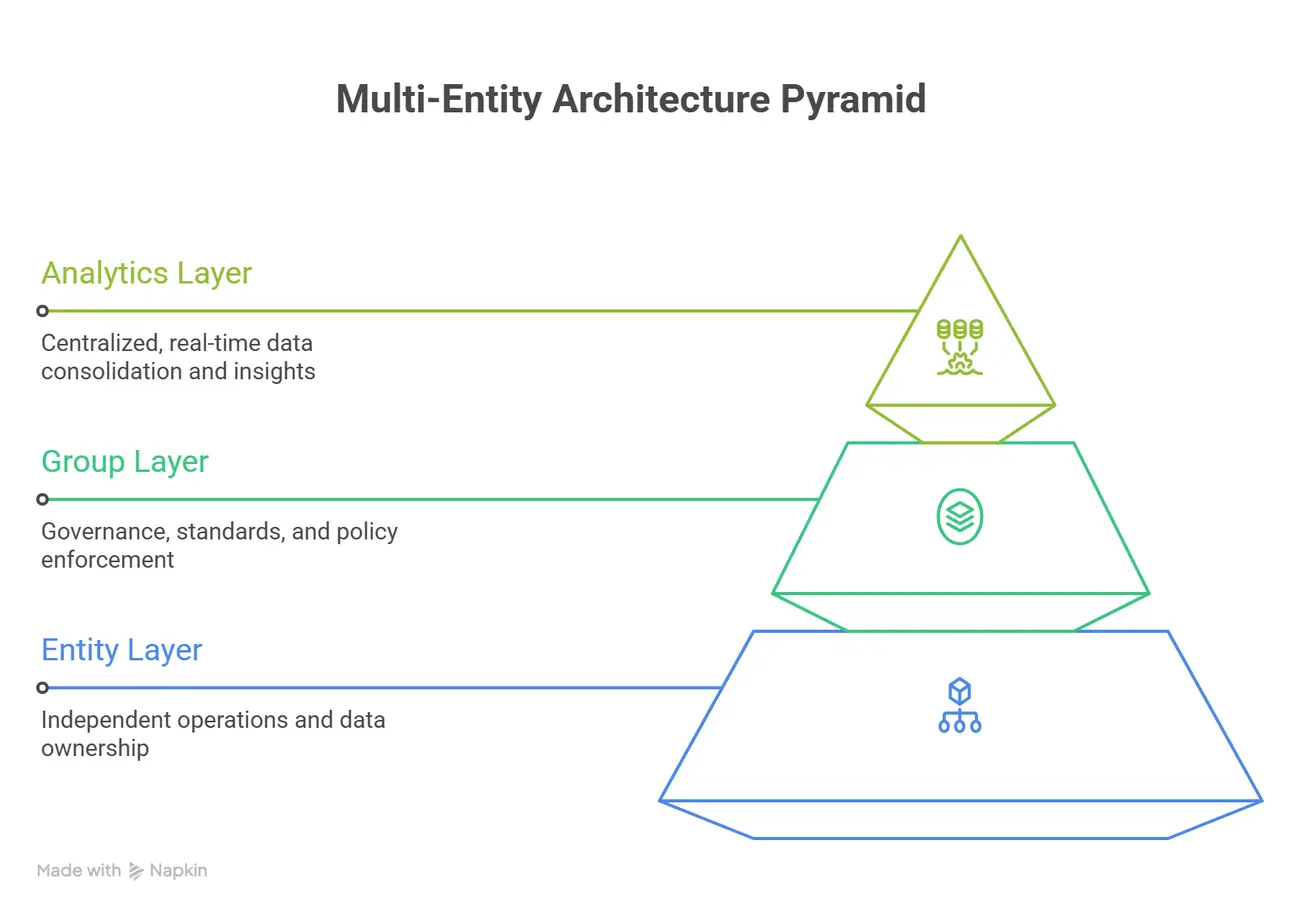
The Three Layers of Multi-Entity Architecture
A modern system should operate across three layers:
1. Entity Layer (Operations)
Each entity has:
- Its own CRM
- Its own projects
- Its own HR records
- Its own communications
This ensures:
- Data ownership
- Regulatory compliance
- Operational independence
2. Group Layer (Governance)
At the group level:
- Leadership defines standards
- Shared services operate
- Policies are enforced
This layer controls:
- User roles
- Data access
- Process frameworks
3. Analytics Layer (Visibility)
This is where consolidation happens:
- Dashboards
- Reports
- KPIs
- Forecasting
This layer should be:
- Centralized
- Real-time
- Flexible
Why Most Systems Fail
Most tools are built for only one layer:
- CRM tools → Entity layer only
- ERP systems → Group + analytics, but rigid
- BI tools → Analytics only
Very few platforms connect all three layers effectively.
Data Isolation vs. Consolidated Reporting
At the core of multi-company management is a paradox: You need separation and consolidation at the same time.
Data isolation means:
- Each entity has its own data environment
- No accidental data leakage
- Clear ownership of records
- Compliance with local regulations
Consolidated reporting means:
- Group-level dashboards
- Cross-entity analytics
- Unified KPIs
- Executive visibility
Most systems can do one – not both. Traditional ERP systems solve this – but at a cost:
- Millions in implementation
- 12–24 month timelines
- Heavy customization
- Dedicated consulting teams
Modern platforms take a different approach. They separate operational environments while enabling data aggregation through integration and reporting layers.

Centralized User Management Across Entities
Another major challenge: your people don't belong to just one entity. You may have:
- Finance teams working across all subsidiaries
- HR managing multiple regions
- Executives overseeing the entire group
- Shared services teams supporting all entities
Managing users across separate systems becomes a nightmare:
- Duplicate accounts
- Inconsistent permissions
- Security risks
A proper holding company software solution should allow:
- Single user identity
- Role-based access per entity
- Controlled cross-entity visibility
- Integration with identity systems (e.g., Active Directory)
This ensures security, simplicity, and scalability.
Shared Services Model
Most holding companies operate some form of shared services:
- Finance
- HR
- IT
- Legal
- Marketing
These teams need to:
- Serve multiple entities
- Access relevant data
- Maintain centralized standards
But in fragmented systems, this is difficult. Shared services end up:
- Logging into multiple systems
- Managing duplicate processes
- Losing efficiency
A modern franchise management platform or multi-entity system should support:
- Centralized departments
- Cross-entity workflows
- Standardized processes
- Shared automation
This allows the group to function as one organism – while preserving entity-level independence.

Introducing Bitrix24 for Holdings and Franchises
This is where Bitrix24 comes in. Bitrix24 is not a traditional ERP. And it's not a single-company workspace either. It's a flexible platform designed to support multi-entity architectures without enterprise complexity.
Multi-Account Architecture in Practice
Let's go deeper into how Bitrix24's architecture works operationally. Each account functions as a fully independent digital workspace, including:
- CRM pipelines specific to that entity
- Project structures aligned to its operations
- Internal communication channels
- Document and file storage
- HR records
- Multiple branch structure
This ensures each company:
- Maintains its identity
- Operates according to its needs
- Meets regulatory requirements
Cross-Entity Collaboration Without Data Leakage
A key advantage of Bitrix24 is enabling collaboration without compromising isolation. For example:
- A central HR team can access employee data across entities – but only within defined permissions
- Finance can view aggregated metrics without accessing raw operational data
- Executives can monitor performance without interfering with daily operations
This is achieved through:
- Role-based access control
- Workspace-level permissions
- API-driven data sharing
Shared Services in Action
Let's take a real-world example. A holding company has:
- 12 entities/branches
- A centralized HR department
- A centralized finance team
Without a unified platform:
- HR logs into 12 systems
- Finance consolidates 12 reports manually
With Bitrix24:
- HR operates from a shared services structure
- Finance accesses consolidated dashboards
- Processes are standardized across entities
This reduces operational overhead, errors, and time spent on admin tasks. But here's the key: these workspaces can still be connected at the group level, through API integrations, BI connectors, shared user management, and custom workflows.
This allows you to maintain independence while achieving central visibility.

Example Architecture (Conceptual)
[ Group Leadership / BI Layer ]
↓
-----------------------------------------------
| | | |
[Entity A] [Entity B] [Entity C] [Entity D]
Workspace Workspace Workspace Workspace
Each entity operates independently. But data flows upward into a consolidated reporting layer.
Why This Matters
Compared to traditional ERP:
- Faster to deploy
- Lower cost
- More flexible
- Easier to scale
Compared to fragmented SaaS:
- Centralized visibility
- Standardized processes
- Better control
Request Multi-Entity Architecture Consultation
If you're managing multiple companies, architecture matters more than features.
👉 Request a consultation to design your ideal setup.
👉 Explore the Bitrix24 enterprise page
👉 Learn about the On-Premise version for full control
Building Consolidated Reporting with BI Integration
Once you've established separate workspaces for each entity, the next challenge is clear: how do you get a unified view of the entire group?
This is where many systems fail. They either:
- Keep data isolated with no way to consolidate
- Or merge everything into one system and lose structure
Bitrix24 solves this through flexible data aggregation using BI tools and integrations.
From Static Reports to Real-Time Intelligence
In traditional setups, reporting looks like this:
- Entities export data
- Finance consolidates manually
- Reports are created weekly or monthly
This creates lag. By the time leadership sees the data, it's already outdated.
With Bitrix24 + BI Builder integration:
- Data flows continuously
- Dashboards update in real time
- Leadership sees live metrics
This shifts organizations from reactive to proactive

Advanced Use Cases for Group Reporting
With proper BI integration, groups can unlock:
1. Cross-Entity Benchmarking
Compare:
- Revenue per employee
- Conversion rates
- Project efficiency
Identify:
- Top-performing entities
- Underperforming areas
- Best practices
2. Resource Optimization
Understand:
- Where teams are over/underutilized
- Which entities need support
- Where to allocate shared services
3. Strategic Forecasting
Combine data across entities to:
- Predict growth
- Plan expansions
- Identify risks early
The Role of BI in Multi-Entity Management
Bitrix24 supports integration with:
- Power BI
- Google Data Studio
- Other analytics platforms via API
Instead of forcing all data into a single operational environment, Bitrix24 allows:
- Each entity to operate independently
- While reporting is centralized at the group level
This creates a clean separation between:
- Operations layer (workspace per entity)
- Analytics layer (group-level dashboards)

What You Can Track at Group Level
With proper setup, leadership can access:
- Total revenue across entities
- Pipeline by brand or region
- Project performance across subsidiaries
- HR metrics (headcount, productivity, turnover)
- Customer acquisition metrics across the group
This eliminates the need for:
- Manual Excel consolidation
- Weekly reporting chaos
- Data reconciliation meetings
Instead, you get real-time, unified visibility.
How Data Flows Across Entities
Bitrix24 enables consolidated reporting through:
- REST API connections between workspaces
- BI connectors for external dashboards
- Custom synchronization where needed
This means:
- Data stays secure within each entity
- But relevant metrics are shared upward
You get the best of both worlds: isolation and consolidation.
Case Study: How a European-Based Holding Unified 15 Entities
Let's look at a practical case using as an example a European-based holding whose name we'll keep in secret for privacy reasons and simply refer to as “holding X”.
The Situation
Holding X is a European-based group managing:
- 15 legal entities
- 600+ employees
- Operations across 4 countries
Each entity used its own tools:
- Different CRMs
- Different project systems
- Different communication tools
The Problems
Leadership faced:
- No consolidated pipeline visibility
- Conflicting data across systems
- High SaaS costs (estimated $120K+/year)
- Complex onboarding processes
- Inconsistent workflows across entities
The CFO described it as: “We had 15 companies – and 15 different versions of reality.”
The Solution: Bitrix24 Multi-Account Architecture
Holding X implemented Bitrix24 with:
- Separate workspace per entity
- Shared services workspace for HR and finance
- BI dashboards for group-level reporting
- Centralized user management
Implementation Approach
They deployed in phases:
- Core entities migrated first
- CRM standardized across all workspaces
- Project management unified
- BI dashboards created for leadership
- Shared services integrated
Results After 9 Months
1. Cost Reduction
- SaaS costs reduced by ~55%
- Eliminated duplicate subscriptions
2. Operational Clarity
- Real-time reporting across all entities
- Standardized KPIs
3. Improved Governance
- Clear data ownership per entity
- Reduced compliance risks
4. Faster Decision-Making
- Leadership dashboards replaced manual reporting
- Weekly reporting cycles reduced to real-time insights
5. Better User Experience
- Single login across workspaces
- Clear role-based access
Lessons Learned
Beyond the numbers, Holding X identified several key lessons.
Lesson 1: Standardization Drives Scalability
Before Bitrix24:
- Each entity operated differently
After Bitrix24:
- Core processes aligned
- Reporting standardized
This enabled:
- Faster onboarding of new entities
- Easier expansion into new markets
Lesson 2: Visibility Changes Behavior
When teams knew performance was visible:
- Accountability increased
- Performance improved
- Collaboration strengthened
Lesson 3: Simplicity Wins
The biggest impact wasn't just consolidation. It was simplification.
- Fewer tools
- Clearer workflows
- Less confusion
Key Takeaway
Bitrix24 allowed Holding X to operate as one group – without losing entity-level structure.
Is your CRM ready? Check the guide
Enter your email to download a guide that will help you get started with any CRM system.
Multi-Entity Platforms Comparison
Let's compare Bitrix24 with traditional enterprise solutions.
Why ERP Systems Fall Short for Many Holdings
ERP systems like SAP and Oracle are powerful – but they come with trade-offs:
- Long implementation cycles
- Heavy customization
- High dependency on consultants
- Limited flexibility post-deployment
For many groups, this results in:
- Over-engineered systems
- Low adoption
- High maintenance costs
The Mid-Market Gap
There's a gap between:
- Lightweight tools (too simple)
- Enterprise ERP (too complex)
Bitrix24 sits in this gap:
- Powerful enough for multi-entity management
- Flexible enough for real operations
- Fast enough to deploy without disruption
Comparison Table
|
Feature |
Bitrix24 |
NetSuite |
SAP S/4HANA |
Sage Intacct |
|
Multi-Entity Support |
Yes (multi-workspace) |
Yes |
Yes |
Yes |
|
Implementation Time |
Weeks |
Months |
1–2 years |
Months |
|
Cost |
Low–Medium |
High |
Very High |
Medium–High |
|
CRM Included |
Yes |
Limited |
No |
No |
|
Project Management |
Yes |
Limited |
No |
No |
|
Communication Tools |
Yes |
No |
No |
No |
|
HR Tools |
Yes |
Limited |
Yes (separate modules) |
Limited |
|
Flexibility |
High |
Medium |
Low |
Medium |
|
Self-Hosted Option |
Yes |
No |
Yes |
No |
Key Differences Explained
Bitrix24 vs NetSuite
NetSuite is a powerful ERP, but:
- Expensive
- Complex to implement
- Primarily finance-focused
Bitrix24 provides broader operational tools (CRM, communication, projects) with faster deployment.
Bitrix24 vs SAP
SAP is enterprise-grade – but:
- Requires large budgets
- Long implementation cycles
- Heavy consulting
Bitrix24 offers a faster, more flexible alternative for mid-market and growing groups.
Bitrix24 vs Sage Intacct
Sage focuses heavily on finance. Bitrix24 expands beyond finance into:
- CRM
- Projects
- Communication
- Automation
Making it a more complete group company management platform.
Key Insight
Traditional systems are strong in finance, but may be weak in operational collaboration. Bitrix24, on the other hand, is balanced across finance, operations, and communication.
Get Enterprise Pricing for Your Group
👉 Request enterprise pricing tailored to your structure
👉 See how Bitrix24 compares to ERP implementations
FAQ for CFOs and COOs
What is multi-entity management software?
Multi-entity management software is a platform designed to manage multiple companies, subsidiaries, or franchises within a single system architecture – while maintaining data separation and enabling consolidated reporting.
How many entities can Bitrix24 support?
Bitrix24 can support:
-
Small groups (5 entities)
-
Large holdings (50+ entities)
Scaling depends on architecture and deployment model.
Can data be isolated between entities?
Yes.Each workspaces operates independently with full data isolation, ensuring:
-
Compliance
-
Security
-
Clear ownership
How does consolidated reporting work?
Through:
-
BI integrations
-
API connections
-
Central dashboards
This allows group-level insights without merging operational data.
Can users access multiple entities?
Yes. Users can:
-
Have one account
-
Access multiple workspaces
-
Be assigned different roles per entity
Is Bitrix24 an ERP system?
Bitrix24 is not a traditional ERP. It is a flexible business platform that covers:
-
CRM
-
Projects
-
HR
-
Communication
-
Automation
While integrating with financial systems where needed.
How does Bitrix24 compare in cost to ERP systems?
Bitrix24 is significantly more cost-effective.
-
No multi-million implementation
-
Faster deployment
-
Lower ongoing costs
Is self-hosting available?
Yes. Bitrix24 offers a self-hosted edition, ideal for:
-
Data sovereignty
-
Compliance requirements
-
Custom infrastructure
Getting started with tasks & projects
Enter your email to download a guide that will get you started with any project management software.

Final Thoughts: From Fragmentation to Control
Managing multiple companies is inherently complex. But your software shouldn't make it harder. The traditional options force you into extremes:
- Fragmentation with separate tools
- Rigidity with heavy ERP systems
Modern multi-entity management requires:
- Flexibility
- Control
- Scalability
Bitrix24 provides a middle path.
Manage Your Group as One Organism
- Separate entities with full data isolation
- Consolidated reporting across the group
- Centralized user management
- Shared services support
- Lower cost than ERP systems
🚀 See How Holdings Use Bitrix24
Discover how companies like yours unify operations.
📊 Request Multi-Entity Architecture Consultation
Get a tailored architecture for your group structure.
💼 Get Enterprise Solution for Your Group
Understand the cost advantage over traditional ERP solutions. Your group of companies should operate as one system. Bitrix24 helps you make that possible – without the complexity.
Multi-entity management is not just a software problem. It's a systems design challenge. The goal is not total centralization or total decentralization.
The goal is controlled autonomy. Each entity operates independently. The group operates intelligently.
The next generation of platforms will:
- Replace fragmented stacks
- Connect operations and analytics
- Enable real-time decision-making
- Scale without complexity
Bitrix24 is built for that future.