Delegation That Survives Your Vacation

You're three days into a hard-earned vacation when your phone buzzes. A client deadline moved. Your team needs approval. A decision only you can make (or so they think). By day five, you’ve barely seen Honolulu beyond the hotel window.
Sound familiar? This isn't about being indispensable. It's about systems that haven't learned to think without you.
True delegation isn't handing off tasks and hoping for the best. It's transferring your judgment, the reasoning behind your decisions, so work flows even when you're offline.
That's the ‘vacation test’: not whether your team can survive without you, but whether your system can lead in your place.
This article shows you how to build that capability using Bitrix24's connected tools. You'll learn how to
- Export your decision-making logic into playbooks.
- Automate approval flows that route themselves.
- Measure whether your team is truly autonomous or just waiting for your next instruction.
By the end, you'll have a blueprint for the kind of delegation that survives your vacation (and scales beyond it).
Tired of vacation pings?
With Bitrix24, document decision logic in Workgroups and automate task routing. Create workflows that keep moving without your direct input.
Try Bitrix24 for freeExporting judgment: the new standard of delegation
Most delegation fails for one simple reason: you hand off the task, but not the thinking behind it. Your team knows what to do, but not how you’d decide when something shifts — a moving deadline, a scope change, a competing priority.
Exporting judgment solves that gap. It means capturing the reasoning, criteria, and boundaries you use to make decisions, and building them directly into your systems. When the logic is documented, your team moves with the same clarity you would, even when you’re offline.
Turning your decision logic into system logic
In practice, it’s decision architecture. You define what should happen when work changes direction, instead of letting every choice come back to you. Bitrix24 makes this practical: Workgroups let you structure workflows, escalation paths, and checkpoints so your judgment sits inside the tools your team already uses.
When your decision logic lives in the system, delegation becomes effortless. Work moves forward without hand-holding, questions answer themselves, and you stop being the default bottleneck. That’s the real test of delegation — not who completes the task, but how confidently the system decides in your place.
Build decision playbooks in Workgroups
Every team needs a single source of truth. A place where judgment, process, and action meet. That’s exactly what Workgroups in Bitrix24 are built for. They become the digital hub where your team learns to make decisions the way you would, even when you’re not there.
Start by turning recurring scenarios into decision playbooks. These can include:
- Standard operating procedures for routine tasks.
- Decision trees for complex or contextual choices.
- Escalation paths showing when to involve others.
- Checklists linked directly to Tasks for consistent follow-through.
Build your first decision playbook in 15 minutes
Choose one recurring scenario that generates the most questions: client scope changes, budget approvals, or urgent requests. Open your relevant Workgroup and create a new Task with a template checklist.
Document the decision path, ie:
“If budget under $5K → approve immediately.
If $5K–$15K → loop in finance lead.
If over $15K → escalate to department head.”
Make the playbook easy to find
Pin this as a Workgroup announcement so it's always visible. Link related Tasks directly to the playbook using Bitrix24's task dependencies. Now when someone faces a scope change, they follow the map you've already drawn instead of reaching out to you directly.
Test it with a role-play
The magic happens when you test it. Assign someone to role-play a scenario using only the playbook. Watch where they hesitate. That's where you add clarity. Within three iterations, you can have a playbook that answers 90% of questions before they're asked.
Connect it to daily work
When you connect these playbooks to task tracking checklists, every team member sees not only what to do but why it matters. If someone steps in while you’re away, there’s no guesswork. The logic is already documented.
Workgroups also keep collaboration contextual. Conversations, files, and tasks stay in one space, tied to specific goals. You can pin decision guidelines, tag key stakeholders, and ensure that projects stay anchored in shared understanding—not scattered across numerous messages or individuals’ memories.
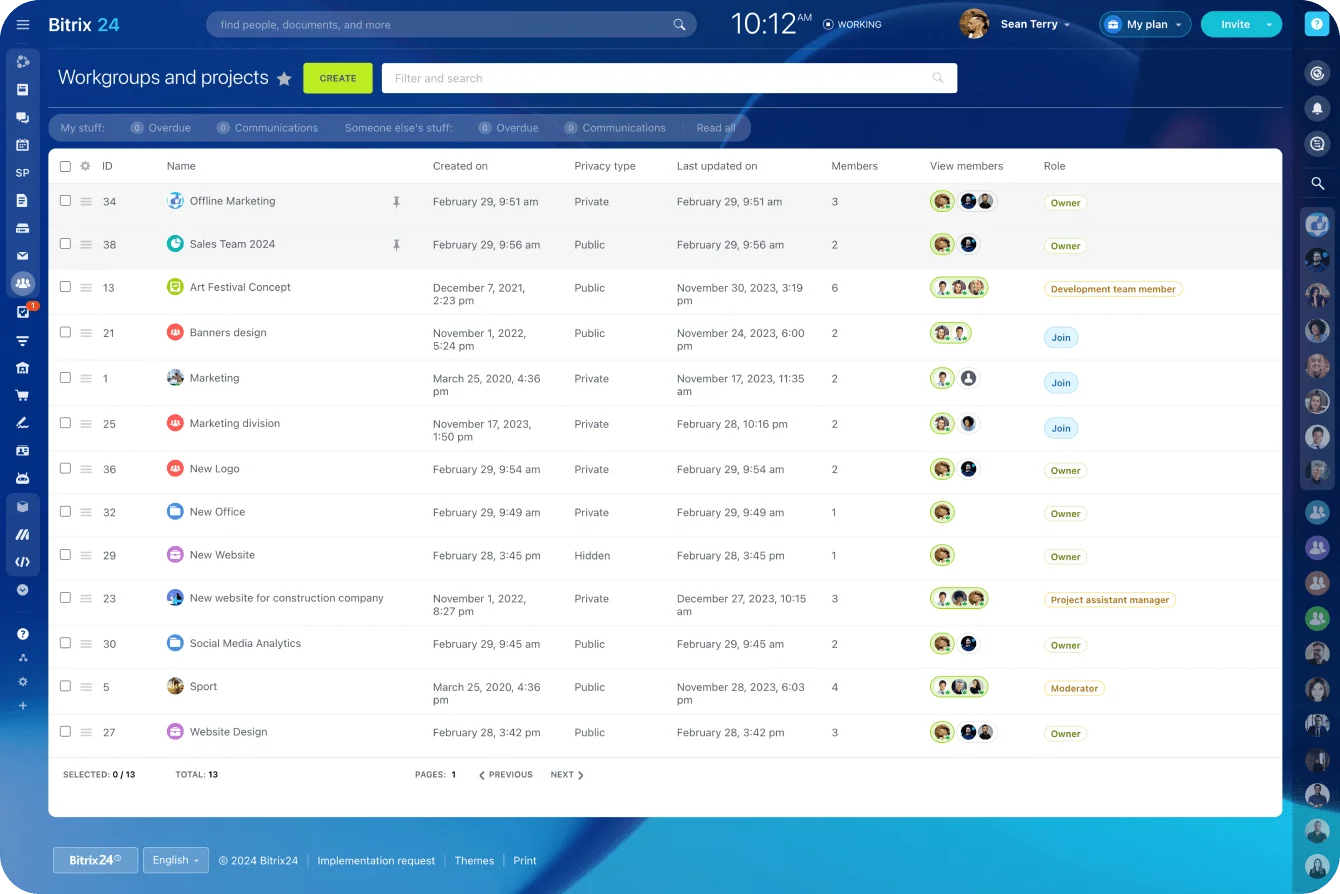
When Workgroups hold your decision logic, your team doesn’t pause when you’re offline. That’s how you build a system that keeps momentum even when you’re out.
When ambiguity spikes: let CoPilot propose next steps
Even the best playbooks can’t cover every scenario. Unexpected client requests, shifting deadlines, or missing context can slow progress and stall decisions. That’s where delegation usually breaks down.
Bitrix24’s CoPilot in Tasks and Projects prevents that freeze. Acting as an intelligent guide, it steps in when clarity disappears, helping your team think, plan, and act without waiting for you. CoPilot can:
- Suggest next steps based on task history and related projects.
- Summarize recent updates to get someone up to speed fast.
- Generate action plans or responses when direction is unclear.
- Highlight dependencies or blockers before they escalate.
It’s more than automation. It’s assisted judgment. CoPilot helps your team reason through problems, not just complete checklists. Over time, they start making decisions that reflect your standards, because CoPilot gives them strong prompts and clarity when judgment is missing..
Shared calendars that route approvals automatically
Approvals are often the hidden bottlenecks in delegation. A project is ready to move forward, but progress halts while it waits for your green light. Multiply that across dozens of small decisions, and productivity slows to a crawl.
Bitrix24’s Shared Calendars remove that friction. They don’t just track schedules, they automate routing, visibility, and ownership so decisions keep moving without you.
Here’s how they help:
- Automatic approval flows: When a task hits a certain stage, it routes automatically to the right person for sign-off. If you’re away, your predefined logic keeps things moving.
- Real-time visibility: Everyone knows who’s responsible, eliminating confusion and hidden dependencies.
- Balanced workloads: Approvals and meetings can redistribute based on availability, so no one becomes a single point of failure.
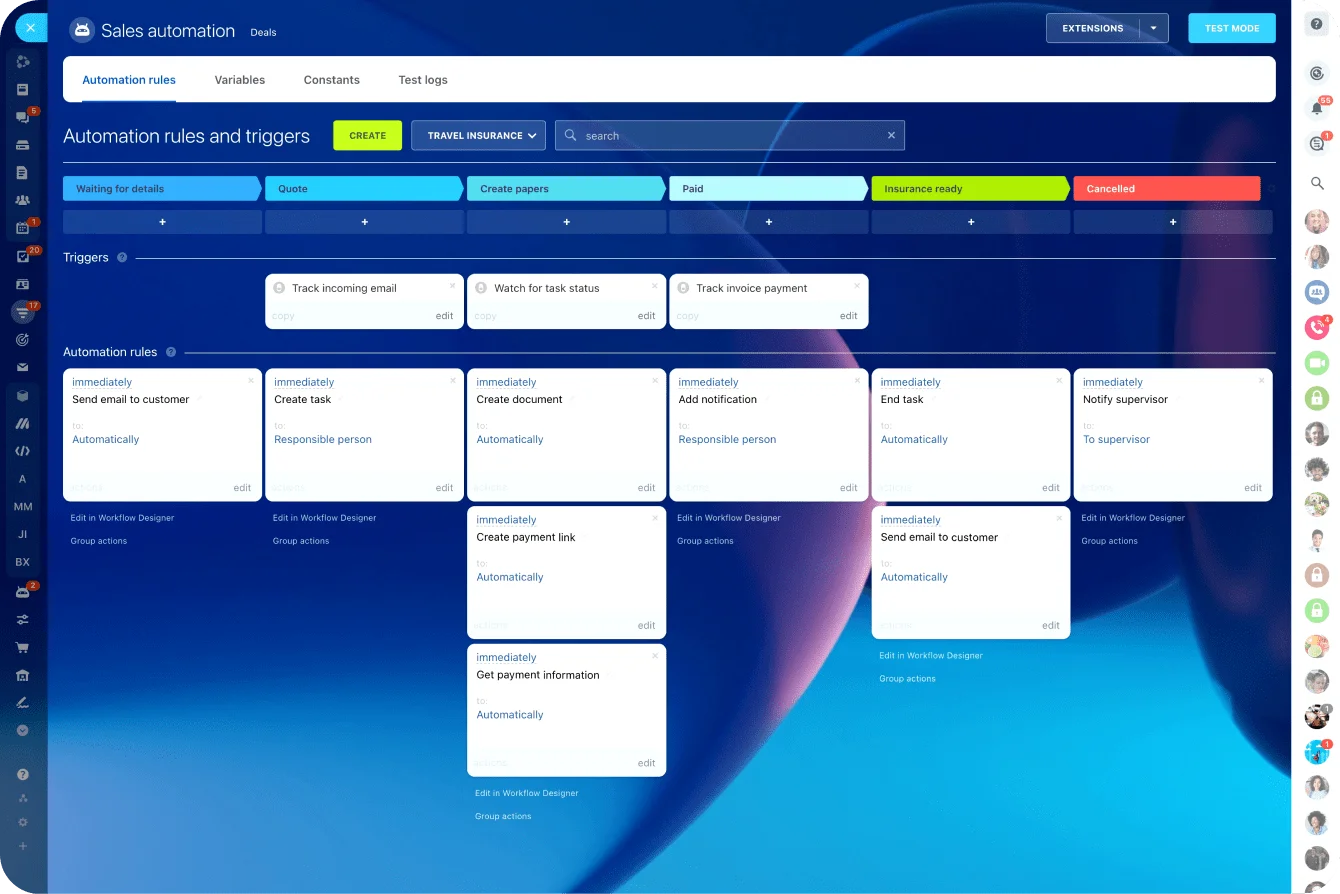
The result is momentum that never stalls. When approvals route themselves, your team acts faster, communication stays fluid, and work keeps moving, even if you’re miles away. That’s the essence of system-led delegation: progress by design, not permission.
HR management and skill matrices: the right owner every time
Delegation breaks down when the wrong person takes ownership. It’s rarely about effort; more often, it’s about fit. The best systems prevent that mismatch before it happens.
With Bitrix24’s HR Management tools, you can map every team member’s strengths, certifications, and experience inside a live skill matrix. When a new task or issue appears, the system instantly identifies who’s best equipped to handle it.
Here’s how it works:
- Skill tracking: Keep profiles updated with roles, competencies, and recent projects.
- Automated assignment: Bitrix24 recommends or auto-assigns tasks to the most qualified person.
- Transparent ownership: Everyone sees who’s responsible, building accountability and clarity.
You can also use these insights to plan ahead. If analytics reveal repeated delays in one stage (say, design reviews) you can proactively cross-train others or expand capacity before your next vacation exposes the gap.
Delegation becomes smoother when your system understands your team as well as you do. Every task finds its best owner, every project stays on track, and your absence no longer slows momentum — it highlights how capable your system truly is.
Cross-training before the crisis: using skill gaps as early warnings
Your skill matrix isn't just for task assignment. It's your early warning system. Run a quarterly gap analysis in Bitrix24's HR Management: which skills appear on only one person? Those are single points of failure.
Before your next vacation, cross-train at least one backup for each critical skill. Create shared Tasks where the expert and learner collaborate, with checklists that capture tribal knowledge. Document their reasoning in Workgroup comments.
When you return, check the Analytics: Did the backup handle tasks independently? That's your succession plan in action, and your next vacation will be even smoother.
Vacation-Proof Delegation Kit
Enter your email address to get a comprehensive, step-by-step guide

Measuring autonomy: the vanity metric worth chasing
Most leaders track productivity, deadlines, or output. But there’s a deeper signal of true team maturity: how much progress happens without you.
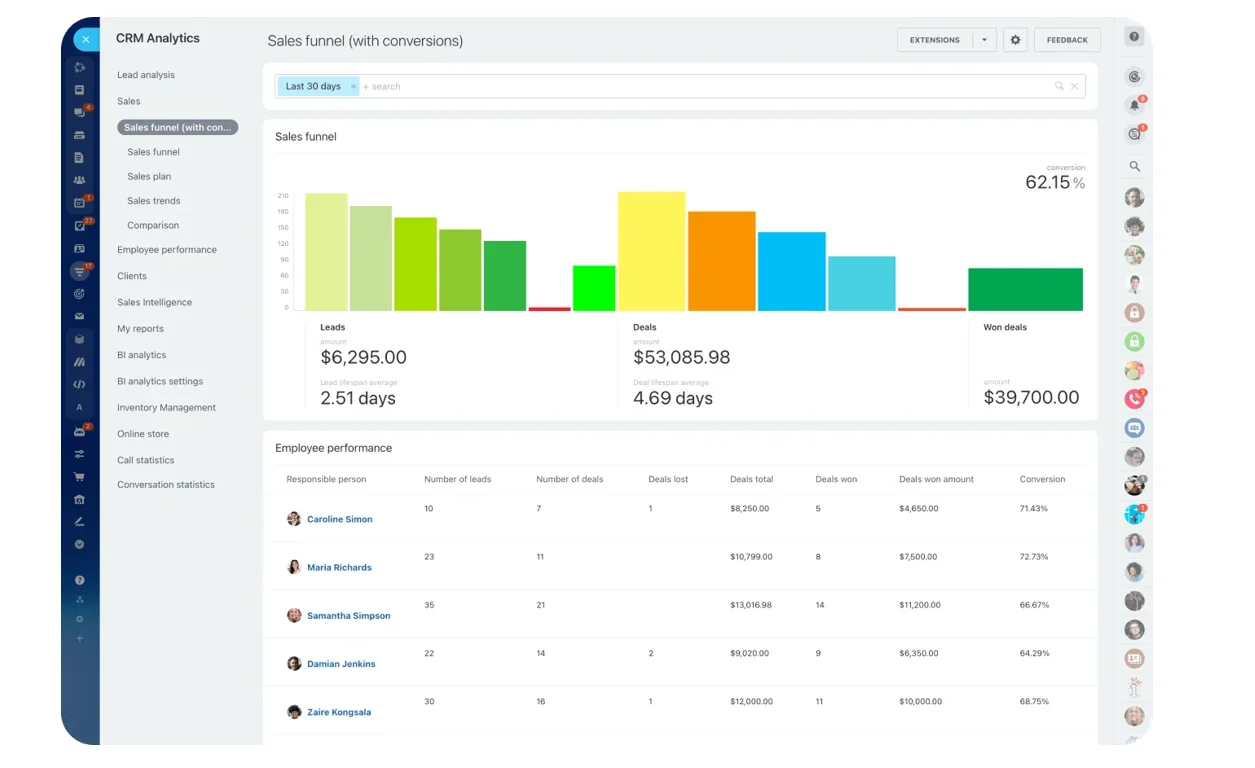
Bitrix24’s Analytics and Reporting make that measurable. The platform shows how many tasks are completed, decisions made, and approvals processed without direct manager input. Think of it as your “autonomy index.” This is a reflection of how self-sufficient your team has become.
Here’s what you can measure:
- Task flow continuity: How many projects move forward while you’re offline.
- Decision speed: Average resolution time when you’re not tagged or mentioned.
- Communication load: How many messages or pings it takes to complete a task (a number that drops sharply with stronger systems).
Some teams using Bitrix24 have reported up to 35% fewer pings during PTO, signaling that structure, not supervision, is driving progress.
This kind of visibility reframes leadership performance. The goal isn’t to manage everything. It’s to design a system so capable it no longer needs constant direction. Over time, you’ll see fewer questions, faster cycles, and more confident decisions.
The irony of control: systems that decide before you must
The real advantage of system-led delegation isn’t about enjoying a quieter vacation. It’s about building a team that moves with clarity every day, whether you’re online or offline.
When decisions flow through documented logic, when approvals route themselves, and when your team knows how to act without waiting for direction, you’re no longer managing activity; you’re enabling progress.
This is where Bitrix24 becomes more than a workspace. It becomes the place where your judgment, priorities, and expectations live in a form your team can use.
The payoff is simple: fewer slowdowns, fewer handoffs landing on your desk, and a team that grows more capable with every cycle.
If you want delegation that holds together when you step back, you need the systems that support it. Start by turning one recurring scenario into a playbook. Build the logic once, let Bitrix24 run it, and watch how quickly your team stops depending on you for every answer.
That’s the kind of delegation that scales — and the kind you can trust.
Work smarter, not harder!
Maximize efficiency with productivity and AI-powered automation tools from Bitrix24.
GET BITRIX24 FREEFrequently Asked Questions
What belongs in a decision playbook?
Focus on scenarios that generate the most questions. Include standard procedures for routine tasks, decision trees for complex choices, escalation paths, and checklists linked to Bitrix24 Tasks. If someone can't reach you, they should still know what you'd decide.
How do we prevent over-automation?
Automate the predictable, not the nuanced. Route approvals, send reminders, and update statuses automatically. Keep human judgment for client negotiations, strategic pivots, and sensitive issues. If a task requires reading between the lines, don't automate it.
How are escalations handled after hours?
Configure Bitrix24 to respect working hours, pausing non-urgent notifications until morning. For genuine emergencies, set conditional routing that alerts an on-call backup based on Shared Calendar availability. True urgency gets through; everything else waits.
What training accelerates judgment handoff?
Run live simulations using real past scenarios. Have team members walk through decisions using your playbooks while you observe. Where they hesitate is where your documentation needs work. Three rounds builds more confidence than a dozen theoretical sessions.
Which KPIs show delegation is working?
Measure autonomy directly: tasks completed without your input, decision speed when you're offline, and messages needed per task. If those numbers improve quarterly, your system is learning to lead without you.