Async Meetings That Actually Work: 11 Rituals to Kill Status Theatre and Keep Decisions


Most meetings have become performance art. People dial in, share updates nobody asked for, nod along to information they could have read in two minutes, and leave without a single decision made. Async meetings offer a way out of this trap - but only if you approach them with intention. The shift from synchronous to asynchronous work isn't about eliminating face time entirely. It's about being ruthless with when you gather people in real time and when you let the work speak for itself.
Teams that master async collaboration report getting back hours every week - time that goes toward actual problem-solving rather than watching colleagues unmute themselves to say "I agree with what Sarah said." The opportunity cost of poorly run meetings adds up fast, especially when you factor in context-switching and the mental drain of back-to-back calls.
This article walks you through 11 rituals that separate effective async meetings from the chaos most teams experience. You'll learn which gatherings deserve calendar time, how to document decisions so they stick, and what leadership habits make or break an async culture.
Why Meetings Became Status Theatre
Somewhere along the way, meetings stopped being about decisions and started being about visibility. People attend just to be seen attending. Managers schedule check-ins because that's what managers do. Calendars end up packed with recurring calls where the same five people share the same updates week after week.
Remote work productivity took a hit during the pandemic, not because people worked from home, but because organizations tried to recreate office dynamics through video calls. Every water cooler conversation became a scheduled meeting. Every quick question turned into a 30-minute block on someone's calendar.
The core problem runs deeper than meeting frequency. Most teams lack systems for making decisions outside of live discussions. When there's no clear process for async workflow, people default to scheduling calls because it feels like progress. A meeting invitation often acts as a proxy for action, even when nothing gets accomplished.
Breaking this cycle requires acknowledging an uncomfortable truth: most meetings exist because we haven't built better alternatives. The rituals that follow give you those alternatives.
Tired of meetings that drain productivity? Transform your remote team with async meetings that actually deliver results.
With Bitrix24, AI-powered tools like CoPilot handle thread summaries and action items, making async collaboration effortless.
Get Started With Bitrix24 Today11 Rituals for Async Clarity and Speed
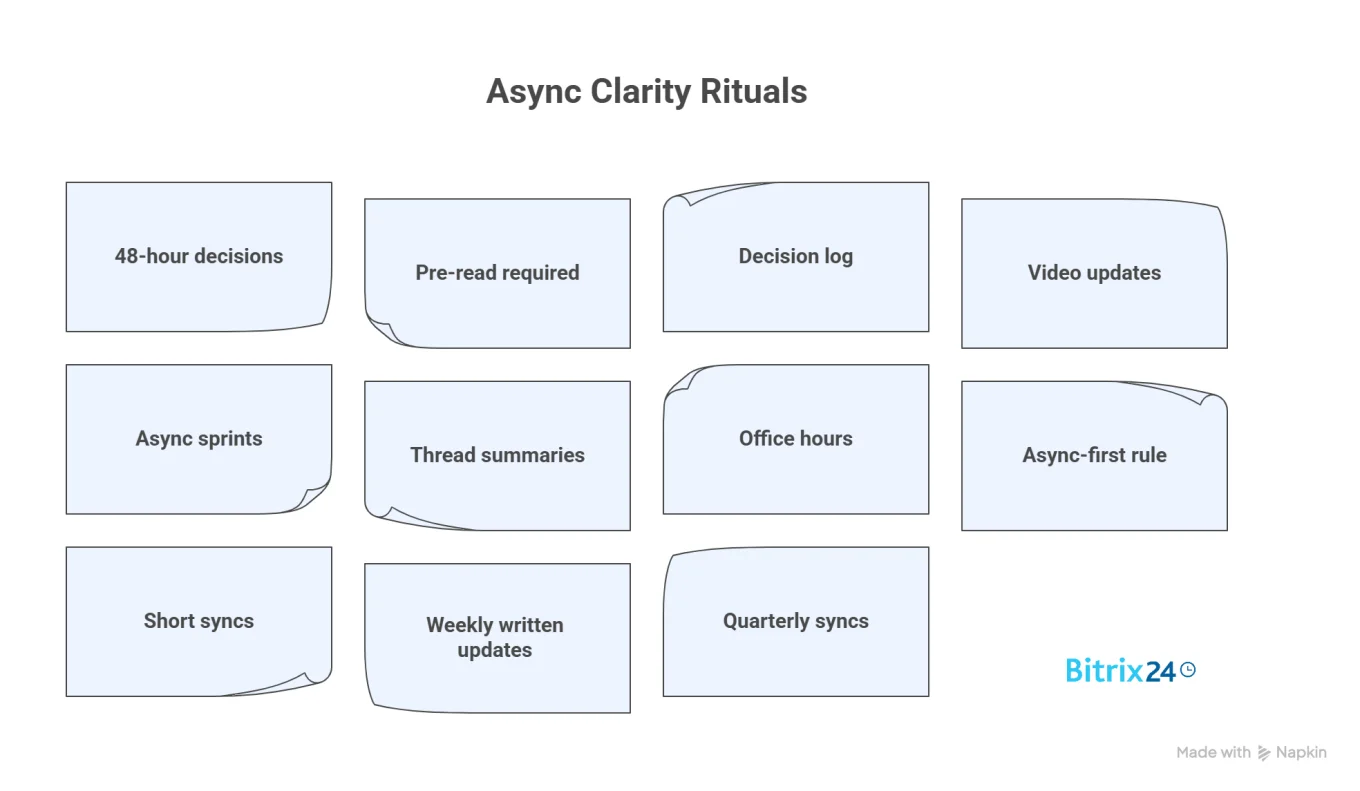
Transforming your team's approach to async meetings takes more than good intentions. You need repeatable practices that become second nature. These 11 decision rituals address the most common failure points in asynchronous work and give you concrete ways to keep decisions moving without constant live check-ins.
Ritual 1: The 48-Hour Decision Window
Every async discussion needs a deadline. Without one, threads drift into limbo - people add comments when they remember, and nothing gets resolved. Set a standard 48-hour window for most decisions. Anyone who needs input can weigh in during that time. Once the window closes, the designated owner makes the call.
This decision ritual works because it creates urgency without requiring synchronous availability. Team members in different time zones get an equal opportunity to participate. The key is sticking to the deadline even when not everyone has responded - silence counts as implicit agreement. Async meetings depend on these clear timeframes to prevent endless discussion loops.
Ritual 2: The Pre-Read Protocol
Before any live meeting (and you'll still have some), require pre-read materials at least 24 hours in advance. These aren't lengthy reports - they're focused documents that lay out context, options, and specific questions that need answers.
When people arrive having done the pre-read, you skip the first 20 minutes of background explanation. Meetings get shorter and more focused on actual decision-making. Teams practicing this ritual often find they can cut meeting duration by half or more.
Ritual 3: The Decision Log
Async meetings fall apart when decisions disappear into thread history. Create a running decision loof face-to-face communication without the sg - a single document or database where every significant choice gets recorded with date, rationale, owner, and next steps.
This log serves as your team's institutional memory. New hires can understand why things work the way they do. Nobody wastes time relitigating settled questions. Decision tracking turns scattered conversations into a coherent record of progress.
Ritual 4: The Video Update
Not everything needs a meeting, but some updates benefit from seeing a face. Weekly video updates - short recordings under five minutes - let leaders share context, celebrate wins, and address concerns without pulling everyone into a call.
Record once, watch anytime. Team members can speed through at 1.5x if they're pressed for time or rewatch sections they missed. This ritual preserves the human connection that pure text lacks while respecting everyone's schedule.
Ritual 5: The Async Sprint
Borrowed from agile methodology but adapted for asynchronous work, async sprints create focused periods where teams work toward specific outcomes without meeting. Define the goal, set the timeframe (usually one to two weeks), and let people execute.
Check-ins happen through brief written updates rather than standups. Questions get posted in dedicated channels. The sprint ends with a recorded demo or written summary. This approach works particularly well for hybrid teamwork, where some people prefer deep work while others thrive on interaction.
Ritual 6: The Thread Summary
Long async discussions generate valuable thinking, but become unreadable fast. Assign someone (or use AI tools) to summarize threads at key intervals. A good summary captures the main arguments, points of agreement, open questions, and proposed next steps.
This ritual makes work visibility possible. Stakeholders who join late can catch up in minutes rather than scrolling through dozens of messages. Thread summaries also serve as input for the decision log once things get resolved.
Ritual 7: The Office Hours Block
Even committed async teams need synchronous touchpoints. Office hours provide them without mandatory attendance. Leaders block regular times when anyone can drop in for quick discussions - no agenda required, no guilt for skipping.
This ritual satisfies the human need for spontaneous connection while protecting focus time. Questions that would otherwise turn into meetings get answered in five minutes. People who work better with live discussion have an outlet that doesn't disrupt everyone else.
Ritual 8: The Async-First Test
Before scheduling any meeting, run it through a simple test: Could this be an email? A recorded video? A shared document with comments? If the answer is yes, don't schedule the meeting. Effective async meetings start with being honest about what actually requires live attendance.
Reserve live time for situations that genuinely require it - sensitive conversations, complex negotiations, creative brainstorming that benefits from real-time energy. Everything else follows an async workflow. This single ritual can eliminate half your recurring meetings within a month.
Ritual 9: The Short Sync
Some discussions need a live conversation but not a full meeting. Short syncs are 10-to-15-minute video calls with a single purpose: resolve one question, align on one decision, or unblock one person. No agenda document needed. No follow-up meeting scheduled.
The discipline here is ending on time, even if you haven't covered everything. If the topic requires more discussion, it probably deserves a proper async thread rather than an extended call. Communication efficiency comes from matching the format to the need.
Ritual 10: The Weekly Written Update
Replace most status meetings with written updates. Every Friday (or whatever day works), team members post brief updates covering what they accomplished, what's planned next, and where they're stuck.
These updates take five minutes to write and three minutes to read. Multiply that across a team of ten, and you've replaced an hour-long meeting with 50 minutes of writing and reading that happens on each person's schedule. The math makes meeting reduction obvious.
Ritual 11: The Quarterly Sync
Async meetings work best when punctuated by occasional in-depth synchronous time. Quarterly team syncs - longer sessions focused on strategy, relationships, and alignment - provide that rhythm.
These aren't status updates. They're working sessions where you tackle challenges that benefit from real-time collaboration. Knowing these sessions exist makes it easier to push other discussions async. You can always table something for the quarterly sync if it truly needs live attention.
How to Build a Culture of Documented Decisions
Rituals only stick when they're embedded in culture. Moving to effective async meetings requires shifting how your team thinks about communication, accountability, and getting work done. Decision rituals start to feel automatic when the surrounding culture supports them.
Start With Leadership Habits
Culture change begins at the top. Leaders who say they support async work but schedule constant calls send mixed messages. If you manage people, audit your own meeting patterns first. Which of your recurring meetings could become async threads? Which decisions are you making in calls that could happen in writing?
Model the behavior you want to see. Post your own video updates. Contribute thoughtfully to async discussions. Celebrate team members who resolve issues without scheduling meetings. The leadership habits you demonstrate matter more than any policy you write.
Create Clear Documentation Standards
Async culture falls apart without documentation. But documentation doesn't mean bureaucracy - it means agreeing on where information lives and how decisions get recorded.
Pick one place for decision logs. Establish templates for common document types. Train people on how to write updates that actually communicate rather than just checking a box. Shared calendars help everyone see availability and deadlines without constant coordination.
Build in Accountability Mechanisms
Async work requires trust, but trust works better with verification. Set expectations for response times. Track whether decisions move forward or stall. Review your team's async practices periodically and adjust what isn't working.
Accountability doesn't mean surveillance. It means creating enough structure that people know what's expected and can hold themselves and each other to those standards. When expectations are clear, most teams rise to meet them.
Address Resistance Directly
Not everyone loves async work. Some people genuinely think better out loud. Others worry that less face time means less visibility for their contributions. Address these concerns openly rather than dismissing them.
Find compromises where they make sense - maybe certain team members get more office hours access, or certain project types default to more synchronous touchpoints. The goal isn't pure async purity. It's finding the right balance for your specific team. Successful async meetings accommodate different working styles while maintaining overall efficiency.
Making Async Work With the Right Tools
Rituals and culture matter, but they need infrastructure to function. The wrong tools create friction that pushes people back toward meetings. The right tools make async collaboration feel natural and help async meetings deliver on their promise.
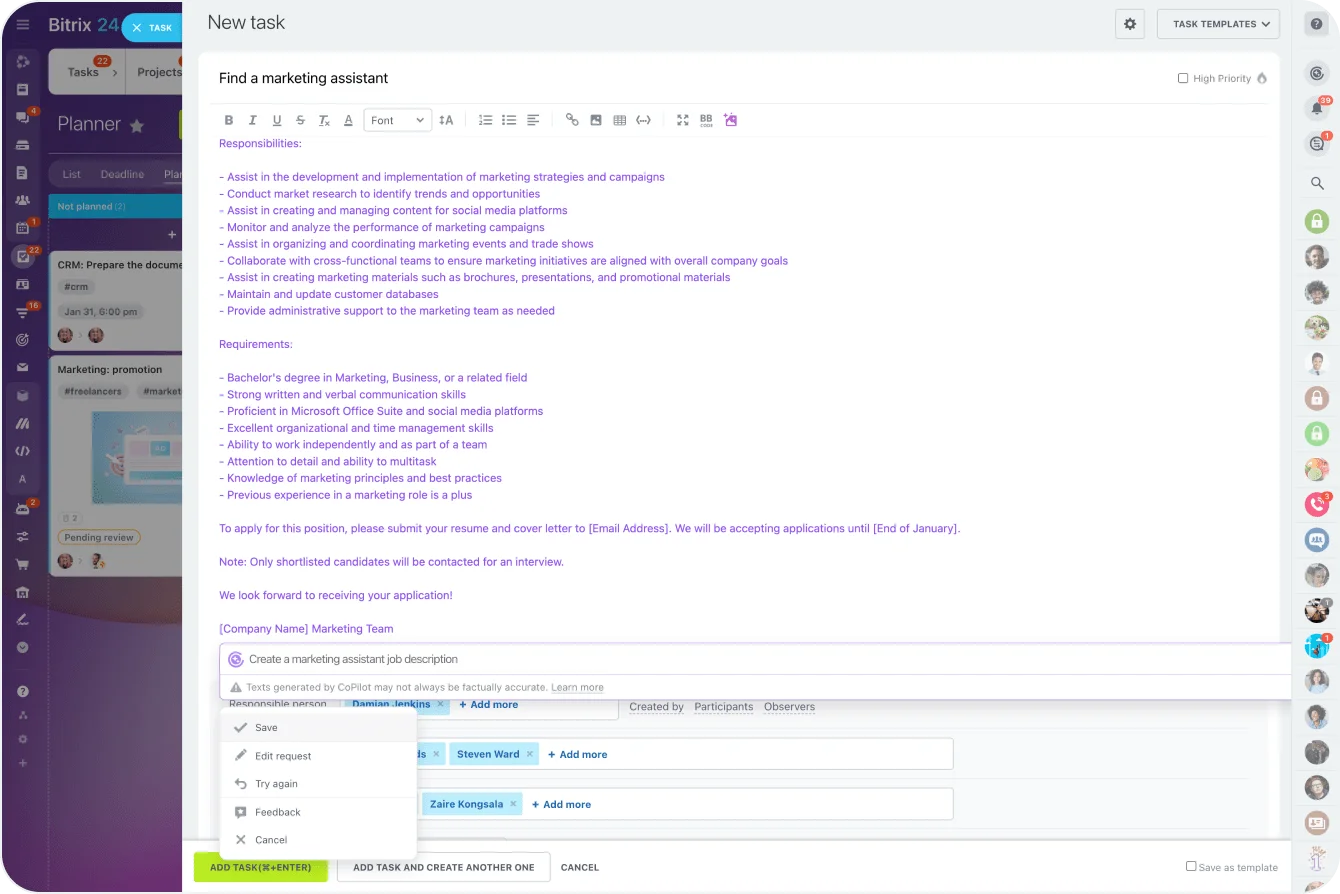
Look for platforms that combine communication, task management, and documentation in one place. When you have to jump between apps to follow a discussion, you lose context and waste time. Bitrix24 CoPilot in Tasks helps by using AI to summarize discussions, extract action items, and keep decisions visible without manual effort.
Video tools that support recording and async viewing expand your options beyond live calls. When someone can record a five-minute explanation and share it for others to watch later, you get the benefits of face-to-face communication without the scheduling gymnastics. Online meetings functionality that includes recording and transcript features makes this seamless.
The integration between tools matters as much as individual features. A decision made in a discussion thread should flow into task assignments without manual copying. Calendar blocks for focus time should be visible to teammates, considering whether to schedule calls. When everything connects, the async workflow stays sustainable.
Reclaim Your Team's Time and Focus
The shift to async meetings isn't about hating meetings or proving something about remote work productivity. It's about respecting people's time and energy enough to only gather them when gathering genuinely helps.
Teams that embrace these rituals report something interesting: the live meetings they do have become better. When you're not exhausted from constant calls, you bring more to the conversations that matter. When you've done pre-reads and contributed to async threads, live discussions move faster. Well-structured async meetings create space for the synchronous work that truly benefits from real-time interaction.
Building an async culture takes patience. Old habits die hard, and there will be moments when scheduling a quick call feels easier than writing a thoughtful async message. That's fine - perfection isn't the goal. Progress is.
Start with one or two rituals that address your team's biggest pain points. Maybe it's the 48-hour decision window for a team that lets discussions drift. Maybe it's the weekly written update for a group drowning in status meetings. Pick something, try it for a month, and see what happens.
Power Your Async Teamwork With Bitrix24
Making these rituals stick is much easier when everything lives in one structured workspace. Bitrix24 brings together shared calendars, tasks, chat, documents, and online meetings, so decisions, context, and execution stay connected instead of scattering across tools.
You can keep a simple decision log in a project or workgroup, link it to relevant tasks, and attach the files that informed the choice. The 48-hour decision window translates into task deadlines, reminders, and automation rules that nudge owners to move things forward. Weekly written updates fit naturally into the activity stream, while video updates and quarterly syncs run through the same online meetings tool, with recording available for anyone who could not attend.
Bitrix24 CoPilot helps with the messy part of async work: turning long discussions into something actionable. It can summarize threads, highlight follow-ups, and suggest tasks so your team does not need a meeting to understand what happened or what comes next. Instead of fighting calendar overload with good intentions alone, you give your async rituals a concrete home.
If you are serious about reducing status theatre and protecting focus time, try running your next project fully inside Bitrix24 with two or three of these rituals. Measure how many meetings disappear, how quickly decisions are recorded, and how often people need to ask, “Where was that decided?” Sign up for Bitrix24 and give your async culture the infrastructure it needs to last.
Better team communication starts here!
Communicate and collaborate seamlessly in Bitrix24: messenger, video conferencing, tasks, files storage, and more.
START NOW FREEFAQs
Which meetings convert well to async formats?
Meetings that convert well to async formats typically include status updates, information sharing sessions, routine check-ins, and decisions that don't require real-time debate. Any meeting where people mainly listen while one person talks is a strong candidate for async conversion. Weekly team updates, project status reviews, and FYI-type announcements all work better as written or recorded updates. Keep live meetings for sensitive personnel discussions, complex negotiations requiring real-time give-and-take, and creative brainstorming sessions where energy builds off spontaneous interaction.
How does AI summarize threads into next steps?
AI summarizes threads into next steps by analyzing conversation content, identifying key discussion points, extracting action items, and flagging unresolved questions. Modern tools like Bitrix24's CoPilot scan through async discussions and pull out what matters - who committed to doing what, which decisions were made, and where disagreement remains. This automation means nobody has to manually read through fifty messages to catch up. The AI creates digestible summaries that respect people's time while preserving the context needed for accountability.
What cadence keeps async teams accountable?
The cadence that keeps async teams accountable combines daily visibility with weekly rhythm and quarterly depth. Daily: brief task updates and quick questions in async channels. Weekly: written updates covering accomplishments, plans, and blockers. Quarterly: longer synchronous sessions for strategy and relationship building. This cadence keeps async teams accountable without micromanaging. The specific timing matters less than consistency - pick a rhythm and stick with it long enough for habits to form.
How do we measure productivity versus time saved?
Measuring productivity versus time saved requires tracking both quantitative and qualitative indicators when evaluating async meetings. On the time side: count meeting hours before and after adopting async rituals, track response times on decisions, and measure how long discussions take to resolve. On the productivity side: look at project completion rates, decision quality (do choices stick or get revisited?), and team satisfaction surveys. The most telling metric is often whether important work actually gets done faster, not just whether calendars look emptier.
How do we onboard teams to async rituals?
Onboarding teams to async rituals works best through gradual introduction rather than wholesale change. Start by converting one or two meeting types to async formats and let people experience the benefits directly. Document expectations clearly - response time standards, where to post updates, and how decisions get recorded. Pair experienced async practitioners with those who struggle. Address resistance with empathy rather than mandates - some people genuinely need more synchronous interaction, and good async cultures accommodate that within reasonable bounds. Give the transition at least two to three months before evaluating whether it's working.