No More Friday Rescues; Ship Wednesdays Instead

For most software teams, Fridays have a way of getting loud. It’s the day when everything unfinished suddenly demands attention, conversations speed up, and people push hard to “get one more thing in.” It’s a rhythm everyone recognizes — and almost no one enjoys.
There’s a better way.
Teams who shift their focus earlier in the week discover something surprising: when the real work happens by Wednesday, the pressure evaporates. Friday becomes a buffer, not a battleground.
This article shows how to make that shift work in the real world. With Bitrix24’s connected project management, real-time visibility, and early-week checkpoints, you can spot issues sooner, clear blockers faster, and ship midweek with confidence.
What follows is a practical playbook for moving your team from Friday rescues to Wednesday releases — and building a cadence that’s calmer, more predictable, and far more sustainable.
The Friday fire drill: why software teams burn out weekly
You know the scene. It’s Friday afternoon, and your team chat lights up like a siren. QA flags a bug. A feature hasn’t been updated. Someone’s still waiting for approval. Within minutes, your sprint turns into a scramble — fixing, testing, and deploying under pressure.
Despite how common this is, it’s rarely a sign of dedication. It’s a sign of late visibility. Small issues that seemed harmless on Tuesday quietly stack up until they explode at the end of the week. Hidden dependencies, unclear ownership, and stale status updates stay invisible until the sprint is nearly over.
The hidden cost of Friday panic mode
Friday rescues don’t just create stressful afternoons — they create long-term damage that slows teams down:
- Burnout accumulation: When engineers expect to work late every Friday, frustration builds. What starts as occasional heroics becomes an unhealthy pattern, and top talent eventually looks elsewhere.
- Quality shortcuts: Under time pressure, teams skip proper testing, documentation, or review. These shortcuts create technical debt that reappears as even bigger issues in future sprints.
- Weekend anxiety: Even when the work stops, the stress doesn’t. Developers spend weekends wondering if rushed Friday deployments will trigger Monday alerts, preventing true recovery.
According to Wellingtone’s 2024 State of Project Management report, 47% of organizations lack access to real-time KPIs — a visibility gap that fuels end-of-week firefighting. Teams aren’t underperforming; they’re reacting to information that surfaces too late to fix calmly.
This isn’t a planning problem. It’s a detection problem. And it’s preventable.
Bitrix24 changes that rhythm. Connected project management and real-time task tracking surface progress, blockers, and stalled work earlier in the week, long before they can turn into Friday emergencies. Instead of rescue missions, Fridays become a space for reflection, refinement, and preparation for the next sprint.
Spot risks before Friday.
Bitrix24 combines task tracking, automation, and team chat in one platform. Proactively manage dependencies and keep sprints on track.
See how it worksThe Wednesday mindset: shipping sooner to breathe easier
The secret to calmer Fridays isn't working harder; it's shifting your focus earlier. The Wednesday Ship mindset is about front-loading effort and accountability. Finish core work by midweek, reserve the end of the week for refinement, reflection, and strategy.
How Bitrix24 supports the shift
Bitrix24 makes this feel natural:
- Dashboard visibility: See every milestone, dependency, and update in one workspace
- Workload balance: Reassign tasks on the fly
- Trend analysis: Identify slow-moving tasks and completion patterns
- Proactive communication: Conversations begin centering around outcomes instead of hours
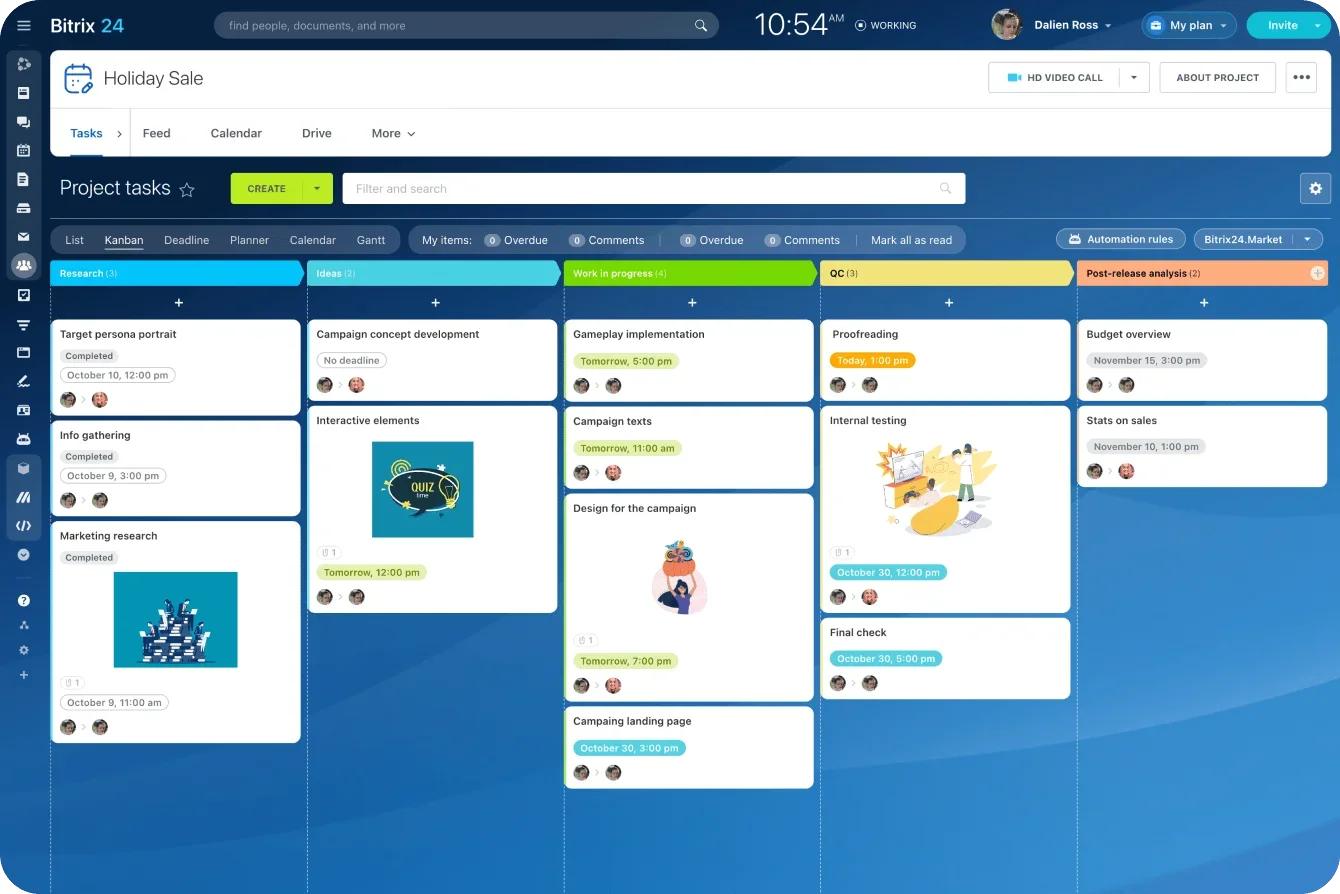
By the time Friday arrives, you're not hoping to hit your sprint goal; everything was already shipped confidently on Wednesday.
Overcoming the "But we'll slow down" objection
The most common pushback to Wednesday shipping is: "If we target Wednesday instead of Friday, won't we just do less work overall?"
It feels like a reasonable concern, but in practice the opposite usually happens. Teams tend to accomplish more when they shift their target earlier, for a few simple reasons:
- Focus improves: When everyone knows Wednesday is ship day, Monday and Tuesday work becomes more intentional. There's less time for low-priority distractions.
- Rework decreases: With Thursday and Friday as buffer days, teams catch quality issues before they reach production. Less rework means more net progress.
- Momentum builds: Successfully shipping on Wednesday builds confidence and team morale. That positive momentum carries into the next sprint, creating a smooth cycle.
Teams using Bitrix24 to support a Wednesday ship cadence usually find that their sprint velocity evens out first, then gradually improves as the new rhythm becomes routine.
Wednesday Shipping Kit: End Friday Fire Drills
Enter your email address to get a comprehensive, step-by-step guide

Tuesday noon reality checks: front-loading accountability
By Tuesday at noon, your sprint's real health is already visible. If you know where to look. That's front-loading accountability: catching small risks before they turn into full-blown emergencies.
In Bitrix24:
- Every task, subtask, and dependency is logged, assigned, and time-stamped.
- With custom automation rules you can configure alerts when tasks go unchanged for a defined period (for example, six hours)..
- CoPilot in Chat highlights risks, suggests quick check-ins, and reminds owners of dependencies.
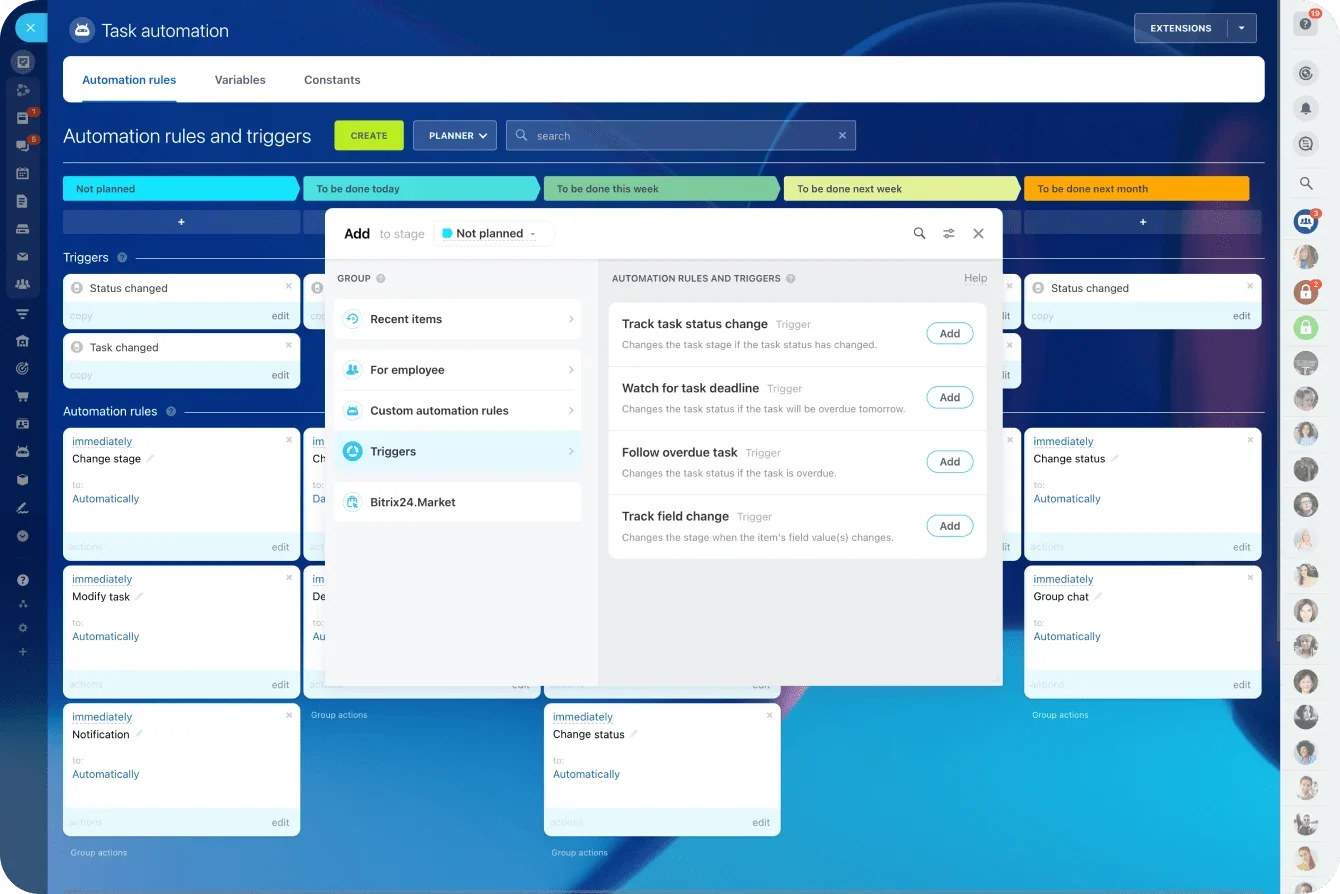
By Tuesday evening, everyone knows what's working, what's stuck, and what needs support. That simple rhythm of review by noon, resolve by night keeps your sprint smooth. You're not predicting how Friday will look like. You already know.
What a Tuesday reality check actually looks like
Here's how high-performing teams structure their Tuesday checkpoint:
- 11:30 AM – Pre-check preparation: Team leads open Bitrix24's dashboard and filter for tasks marked "In Progress" or "Testing." They scan for any items without updates in the past six hours.
- 12:00 PM – Quick standup (15 minutes max): Rather than everyone reporting status, the team focuses only on flagged items. "Why hasn't this moved?" becomes the central question. No blame, just clarity.
- 12:15 PM – Action assignment: For each blocker identified, someone takes ownership of unblocking it by the end of day. These get added to a "Tuesday Unblock" task list in Bitrix24, with clear deadlines and accountability.
- 5:00 PM – Resolution check: Before logging off, team leads verify that blockers have been cleared or escalated. Anything still stuck gets priority attention Wednesday morning.
Pro tip: Set up automated notifications in Bitrix24 to alert team leads when tasks haven't been updated by noon on Tuesday. This creates a consistent accountability checkpoint without requiring manual monitoring.
Defining "done" — not just "delivered"
One major reason Friday pressure builds: “done” means something different to everyone. Developers stop at working code. QA waits for tests. Project managers wait for deployment. Those mismatched expectations create confusion that only shows up when it’s almost too late.
Building shared clarity
Align on a shared definition of "done" and use Workgroups to make it visible. Include checklists like:
- Code reviewed
- Documentation updated
- QA approved
- Client handoff verified
Within task tracking, these rules link to progress bars and reports. By Wednesday, your team can review deliverables against the full checklist, and CoPilot confirms dependencies are cleared. Predictability replaces uncertainty.
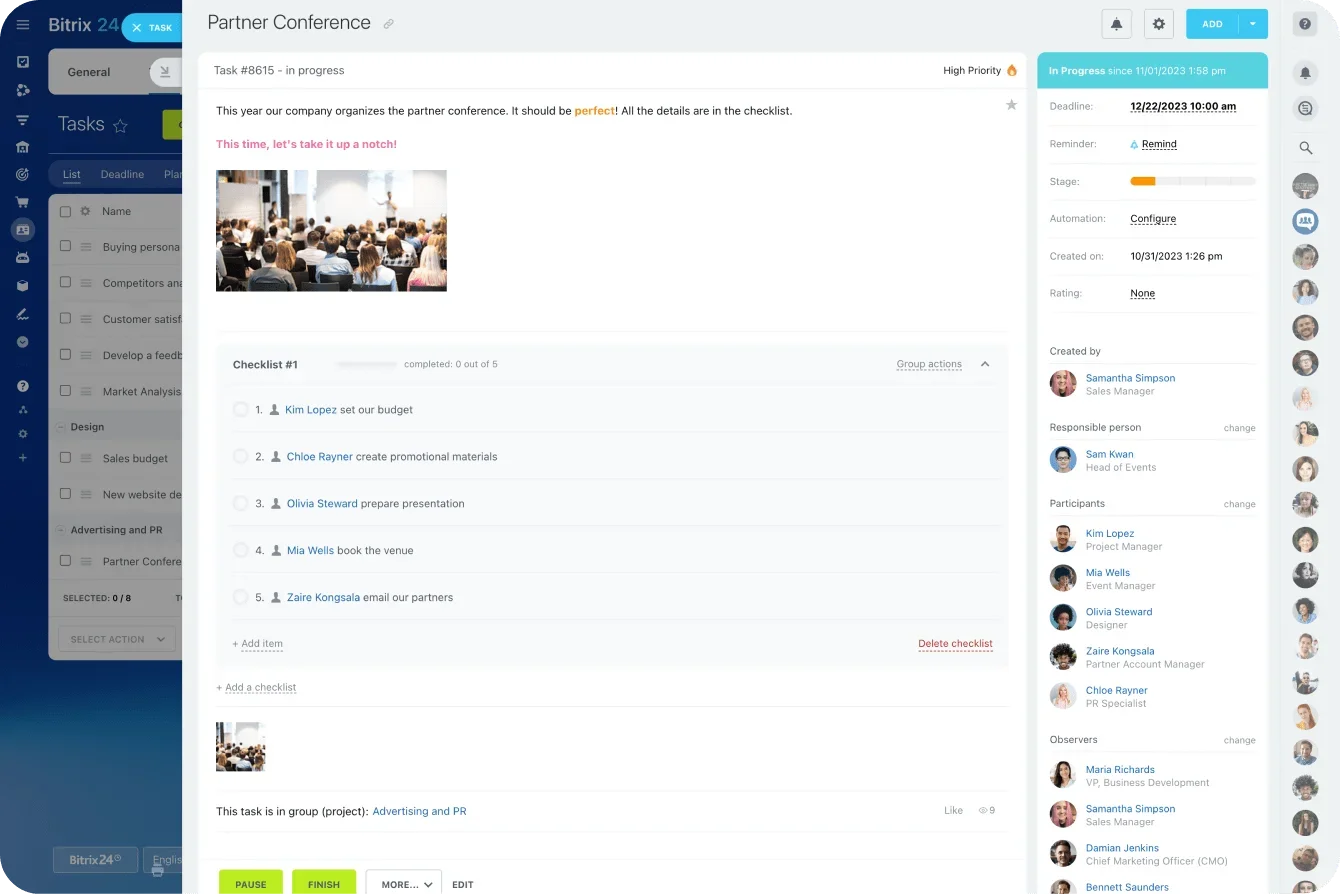
Creating your team's definition of "done"
Every team’s checklist will differ, but the process of creating one follows a predictable pattern:
- Gather stakeholders — Dev, QA, design, product, PM. Everyone brings a different assumption about what “done” means.
- Map your real workflow — Walk through a recently completed task. Where were the handoffs? Where did delays happen? Real examples reveal gaps theory doesn’t.
- Document the non-negotiables — Build the final checklist directly into your Bitrix24 task templates so it’s visible and enforceable.
- Test and refine — Use the definition for a sprint, gather feedback, and adjust.
- Make it visible — Pin it in your Workgroup, use it in onboarding, reference it in sprint planning.
Bitrix24 can even verify certain criteria automatically (checking whether code reviews, documentation updates, or subtasks are complete) before a task can be marked done.
The "Wednesday Ship" API rule: automating risk awareness
Even strong workflows miss hidden risks, especially in fast-paced development cycles. That’s where automation matters. A simple “Wednesday Ship” rule in Bitrix24 acts as an early-warning system, surfacing high-risk tasks before they turn into end-of-week emergencies.
How it works
When a task meets predefined criteria (critical, stalled, or drifting toward a deadline), Bitrix24 automatically mirrors it into a dedicated “Wednesday Ship” Workgroup. Stakeholders can review the issue in context, discuss solutions, and take action. Online meetings trigger only when they’re genuinely needed, not as standing rituals.
Making risk patterns visible
From the Workgroup, Bitrix24’s dashboards and automation tools reveal the patterns behind your slowdowns:
- repeated delays
- bottlenecked dependencies
- workload imbalances
The goal isn’t more process. It’s fewer surprises. Early visibility becomes baked into the way your team works, instead of something you scramble for at the end of the week.
Setting up your Wednesday Ship automation
You can implement this rule in under 30 minutes without writing any code. The core steps:
- Create the Wednesday Ship Workgroup
Use it as a focused space for at-risk items. Limit notifications to team leads and PMs to avoid noise.
- Configure automation triggers
Common criteria include:
- tasks marked Critical or Blocked
- tasks “In Progress” for more than 48 hours
- deadlines approaching with no movement
- comment threads containing keywords like “stuck” or “waiting”
- Set smart notifications
Use digest alerts (e.g., Tuesday 11 AM and Wednesday 9 AM) so visibility improves without notification fatigue.
- Link to meeting automation
When multiple flagged tasks belong to the same feature or epic, Bitrix24 can automatically suggest or schedule a quick sync. Meeting links and context appear directly in the task comments.
- Build feedback loops
Review flagged tasks at the end of each sprint and tweak the rules. The system becomes more accurate the more your team uses it.
Teams often find that once automations are tuned, most potential Friday fire drills are caught by Tuesday afternoon, when they’re still easy to fix.
Keep Fridays for future thinking
When you start shipping by Wednesday, Fridays shift from recovery mode to runway. The deadlines are behind you, the work is stable, and the team finally has space to look ahead instead of looking over their shoulder.
That extra breathing room isn’t downtime; it’s the margin high-performing teams use to sharpen their process. A quick retrospective, a documentation sweep, a small experiment that never fits mid-spring. These are the quiet investments that make the next cycle smoother than the last.
Bitrix24 supports this rhythm by keeping everything connected. Upcoming work stays visible in your project views, Workgroups collect improvements and decisions as you go, and CoPilot helps distill the week into clear, actionable insights. Fridays become purposeful without being pressured.
This is what a sustainable development cadence feels like: predictable weeks, clearer handoffs, and the confidence that comes from finishing early—not crashing late.
You don’t have to spend Fridays saving the sprint anymore. Ship on Wednesday, reset on Thursday, and use Friday to think, refine, and prepare for what’s next.
Try it yourself: Start with Bitrix24’s free plan and run your first Wednesday Ship sprint. You’ll feel the difference by the end of the week.
Getting started with tasks & projects
Enter your email to download a guide that will get you started with any project management software.

Frequently Asked Questions
How do we choose the Wednesday checkpoint?
Move your "completion target" two days earlier than the current sprint end date. Wednesday becomes your internal ship date, leaving Thursday and Friday for refinement and buffer. Bitrix24 allows custom deadlines to reflect this shift.
What signals predict a Friday fire drill?
Tasks not updated in six hours, flagged dependencies, and blockers reported in chat without corresponding task updates are red flags. Bitrix24's analytics surface these patterns by Tuesday afternoon.
Do we need to migrate from our current tool?
Not necessarily. Bitrix24 integrates with popular tools and can run alongside your existing setup. Teams often start with task tracking and gradually adopt full project management.
How are stakeholders kept informed without meetings?
Activity streams, automated reports, and dashboards give real-time visibility. CoPilot generates status summaries on demand. Meetings are triggered only for genuine blockers, not routine updates.
What KPIs prove improved predictability?
Track sprint completion rate, average time from in-progress to done, tasks missing their target dates, and frequency of after-hours work. Teams using the Wednesday Ship approach typically see steady improvements in completion rates over the first month, along with measurable reductions in late-night deployments and weekend work.