Sales Forecasting That Doesn't Lie: 7 Ways to Build a Pipeline You Can Actually Trust
Your pipeline shows $2 million. Your CEO asks if the quarter is safe. You say yes. Then three deals slip, two ghost you completely, and suddenly you're scrambling to explain a 40% miss.
This scenario plays out in sales organizations every quarter.
The problem isn't your sales team's effort or your market conditions. It's that most sales forecasting relies on data that's incomplete, outdated, or flat-out wrong. Manual updates get skipped. Different departments track different metrics. Someone marks a deal as "90% likely" based purely on optimism. By the time leadership reviews the numbers, they're looking at fiction dressed up as facts.
The gap between your reported pipeline and actual buying activity can be staggering. Marketing counts leads one way, sales counts them another. Chat conversations happen in one system, email in another, website behavior in a third. No single source reflects what's really happening with your prospects. This fragmentation muddies your view and actively sabotages your ability to predict revenue with any confidence.
Building trustworthy sales forecasting means creating a system that captures real intent signals, updates itself continuously, and minimizes the human error that derails accuracy. It requires rethinking how you collect data, define stages, calculate probabilities, and involve your team in maintaining the truth.
Here are seven ways companies can turn their sales forecasting from guesswork into something they can genuinely plan around.
If your current forecast still depends on spreadsheets, gut feel, or last-minute updates, it’s time to change the system.
Bitrix24 unifies your pipeline, automates CRM accuracy, and gives you the insight you need to plan with confidence.
Start Using Bitrix24 Today1. Centralize All Buyer Signals in One Place
Pipeline reliability starts with consolidation. When your CRM holds one piece of the story, your marketing automation another, your chat platform a third, and your ads yet another, you're not forecasting; you're stitching together fragments and hoping they make sense.
Every interaction a prospect has with your company is a signal. Downloads, page visits, email opens, chat questions, event attendance, ad clicks, and offline conversations, all of these reveal intent. But if they live in separate silos, you can't see the full picture. A prospect might visit your pricing page five times, ask about implementation in a chat, and then go silent on email. Is that deal progressing or stalling? Without unified data, you're flying blind.
Fragmented data isn't just inconvenient; it's the single biggest source of inaccurate forecasts. Reps make decisions based on partial information. Managers assess pipeline health unaware of what marketing saw or what customer success flagged. The forecast you present to leadership reflects only the channels someone remembered to check.
Bringing everything into one platform eliminates these blind spots. When chat logs, website behavior, email engagement, ad interactions, and CRM notes all flow into the same system, patterns emerge. You see which prospects are genuinely engaged versus which ones filled out a form months ago and never returned. That clarity directly improves your ability to predict which deals will actually close.
Bitrix24 unifies these signals naturally. Its built-in CRM connects to your website forms, live chat, email, telephony, social media, and marketing automation. Every touchpoint feeds the same contact record, giving you a complete view of buyer behavior and making it clear which system holds the latest information.
2. Score Leads Based on Intent, Not Form Fills
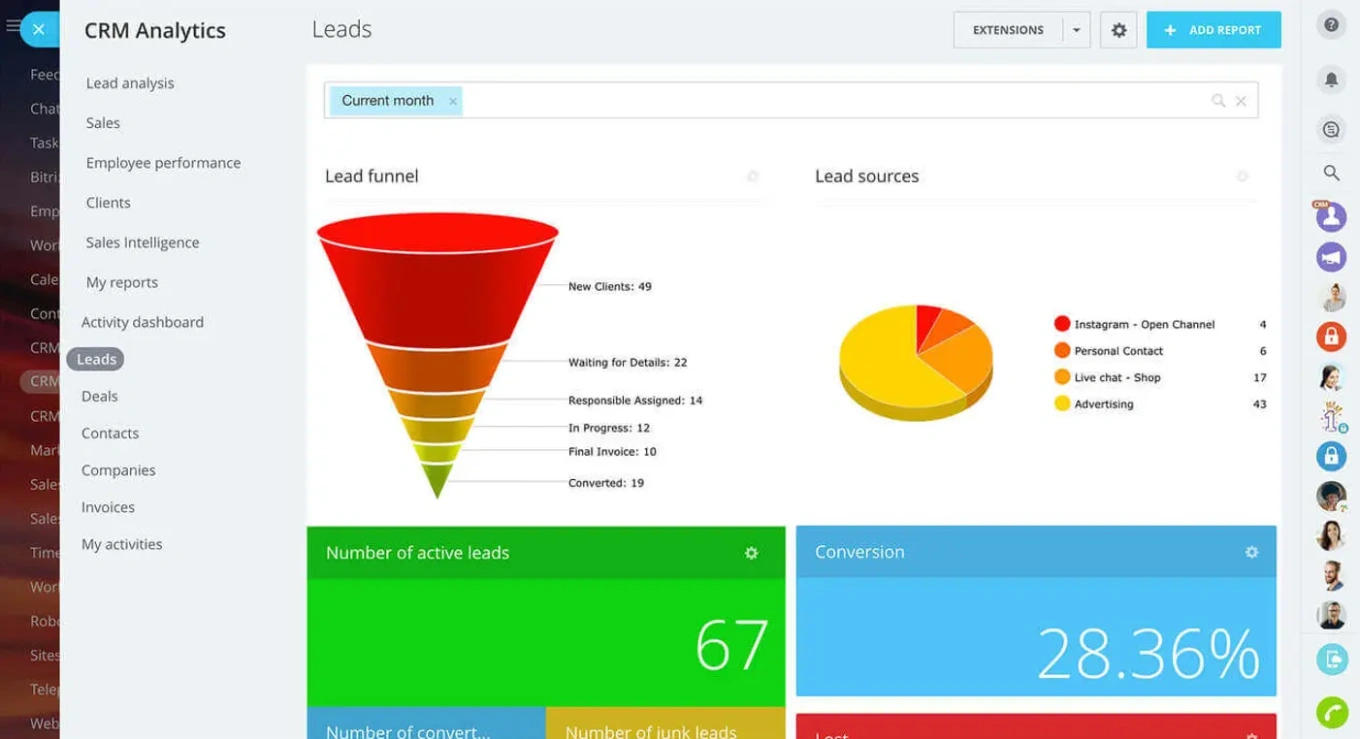
Form submissions matter, but they don't tell you everything. Someone downloading a whitepaper might be a junior analyst doing research, or they might be a VP three weeks from making a purchase. Treating both the same creates noise in your pipeline and ruins forecast accuracy.
Behavioral signals offer much richer insight. How deeply is someone exploring your content? Did they visit once and disappear, or have they come back five times in three days? Are they reading generic blog posts or diving into product documentation and pricing details? Which decision-makers at the company are engaging, and how frequently?
Data-driven sales teams prioritize these patterns over static form data. They assign higher scores to prospects who demonstrate sustained interest, involve multiple stakeholders, and engage with bottom-of-funnel content. These scores update automatically as behavior changes, so your forecast reflects current reality instead of outdated assumptions.
Dynamic scoring removes guesswork from qualification. A deal that looked promising two weeks ago but hasn't seen any activity since should automatically drop in priority. Conversely, an account that suddenly spikes in engagement deserves immediate attention. When your system adjusts scoring in real time, your sales forecasting becomes responsive to actual buyer behavior.
This approach also improves rep accountability. Sales teams can't inflate the pipeline with cold leads because the scoring model exposes low engagement. Everyone operates from the same data-backed assessment of where each opportunity truly stands.
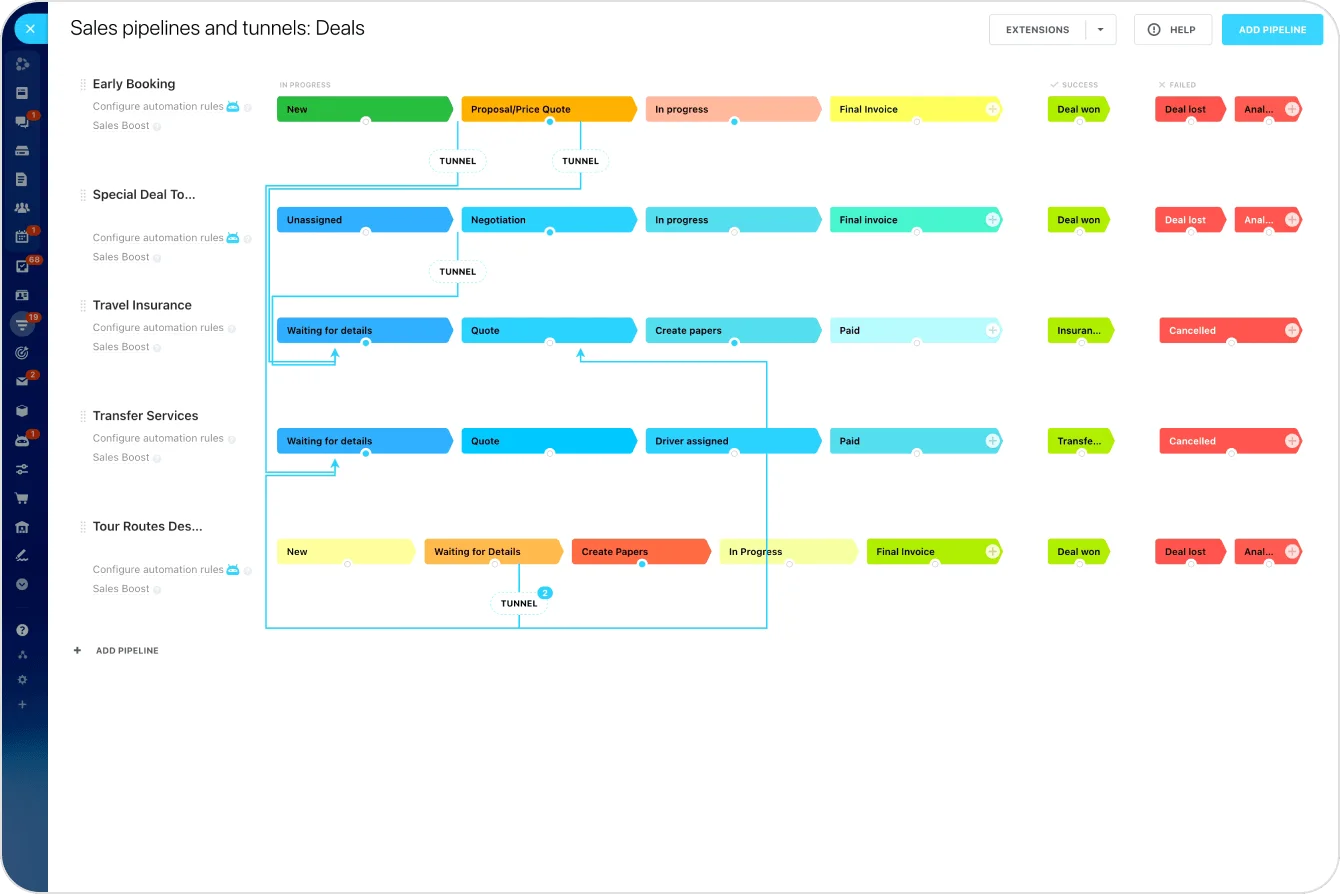
3. Qualify Opportunities With Crystal-Clear Stages
Ambiguous stage definitions destroy forecasts faster than anything else. When one rep's "Qualified" equals another rep's "Discovery," stops being useful. Terms like "In Discussion" or "Evaluating" sound precise but remain meaningless in the absence of clear entry and exit criteria.
Objective, auditable stage definitions fix this. Each stage should have specific requirements that a deal must meet before advancing. For example, "Discovery" might require a completed needs assessment call with documented pain points and a budget range. "Proposal" might require formal presentation delivery and confirmation of the decision timeline. No gut feelings, no ambiguity.
These criteria make stage movement trackable and honest. Managers can audit whether deals actually meet the requirements for their current stage. Reps can't push opportunities forward just to make the pipeline look better. Most importantly, CRM analytics are genuinely dependable, because every deal at a given stage now shares similar characteristics.
Exit criteria matter just as much. Defining what must happen for a deal to leave a stage, not just enter it, prevents stagnation. If a deal sits in "Negotiation" for three months without a signed contract or a specific next step, it probably doesn't belong there. Your stage definitions should force honest reassessment.
Well-defined stages also enable weighted forecasting that actually works. When you know precisely what "Proposal" means across all reps and all deals, you can confidently apply a consistent probability to every opportunity at that stage. This consistency is what separates reliable sales forecasting from optimistic fiction.
Honest Sales Forecasting Kit: 7 Pipeline Fixes
Enter your email address to get a comprehensive, step-by-step guide

4. Use Real Conversion Rates, Not Aspirational Ones
Here's a test: ask three different people in your organization what percentage of qualified leads typically close, and how long that takes. You'll probably get three different answers, none of them based on data.
Most companies build forecasts on wishful thinking. They assign 70% probability to late-stage deals because that feels right, or because that's what the industry benchmark says. They estimate 45-day sales cycles because that's what they hope for. Then reality hits, and the numbers don't match.
Accurate sales forecasts require using your actual historical performance, calculated from rolling averages. What percentage of your "Qualified" opportunities have actually progressed to "Discovery" over the last six months? How many "Proposals" have closed, and how long did it take? These numbers don't lie, and they give you a realistic foundation for prediction.
Replacing gut-feel estimates with consistent probability logic transforms forecast accuracy. When you know from data that 30% of opportunities at Stage 3 typically close within 60 days, you can project pipeline outcomes with confidence. This removes personal bias and gives everyone a shared understanding of what the numbers mean.
CRM metrics make this possible, but only if your system tracks stage movement and timestamps reliably. You need to see not just where deals are, but how long they've been there and where they came from. Trends emerge from this historical view - patterns about which source channels convert best, which deal sizes move fastest, and which industries close most reliably.
Bitrix24 helps you analyze these patterns more systematically. The platform tracks conversion rates between stages, flags deals that move more slowly or quickly than usual, and makes it easier to spot trends that are hard to see in spreadsheets. Used consistently, these insights support more realistic, data-driven forecasts.

5. Sync Sales and Marketing Around One Pipeline Definition
Nothing inflates the pipeline faster than misalignment between departments. Marketing counts 500 new leads this month; sales says they received 200. Marketing calls it a qualified opportunity; sales calls it a cold inquiry. Different definitions create double-counting, duplicate efforts, and wildly inaccurate forecasts.
Revenue predictability requires a unified language. Sales and marketing must agree on what constitutes a lead, what qualifies it, when it becomes an opportunity, and what defines a buyer ready for outreach. These aren't semantic debates; they're operational requirements for honest pipeline reporting.
Start by documenting your funnel stages and requiring both teams to use them consistently. A lead isn't just someone who filled out a form; it's someone who meets specific criteria for fit and interest. An opportunity isn't just a scheduled demo; it's an account with confirmed need, budget, and timeline. When everyone uses the same definitions, you eliminate the phantom pipeline that exists only because teams are counting different things.
This alignment also prevents inflated numbers from creeping into executive dashboards. If marketing generates a lead but sales hasn't accepted it, does it count toward the pipeline? If a rep marks something as "Opportunity" but it doesn't meet the qualification criteria, should leadership see it? Clear processes and shared definitions answer these questions before they create forecast problems.
Regular sync meetings help maintain alignment over time. Definitions drift as teams evolve, so quarterly reviews ensure everyone still speaks the same language. These sessions also reveal friction points - maybe sales consistently rejects leads from a certain source, signaling that marketing's targeting needs adjustment.
6. Automate Pipeline Hygiene
Manual pipeline cleanup never happens consistently. Reps get busy, managers get distracted, and slowly your CRM fills with duplicates, outdated contacts, orphaned accounts, and deals that should have been closed months ago. This decay doesn't just clutter your view-it actively corrupts your sales forecasting.
Sales automation solves this by checking data quality continuously. Automated workflows can scan for duplicate records daily, merge them according to predefined rules, and alert admins to manual review cases. They can flag opportunities that haven’t seen recent activity, prompt reps to update stale deals, and reassign accounts when ownership changes.
Missing critical fields also sabotage pipeline modeling. If half your opportunities lack estimated close dates or deal values, your forecast calculations end up unreliable. Automation can require these fields at specific stages, preventing incomplete data from entering your reporting. This enforcement happens at the point of entry, eliminating the need for cleanup later.
Unassigned accounts and contacts create another source of error. When leads come in but don't get routed to anyone, they sit invisible until someone stumbles across them. Automated assignment rules distribute new records immediately based on territory, product interest, or deal size. Every opportunity has an owner from day one, and nothing falls through the cracks.
Bitrix24 includes robust automation tools that maintain pipeline health without manual intervention. You can configure workflows to detect data issues, trigger cleanup actions, and notify the right people when attention is needed. These automations run continuously in the background, ensuring your CRM analytics always reflect current, accurate information.
Regular hygiene not only improves forecast accuracy, it also frees your team to focus on selling instead of data entry. When the system handles routine maintenance, reps spend their time on conversations that move deals forward.
7. Bring AI Into the Forecasting Backbone
Human judgment has limits. Even the best sales managers struggle to spot subtle patterns across hundreds of deals, identify early warning signs, or predict which opportunities will unexpectedly accelerate. AI fills these gaps by processing more variables than any person could track.
Predictive dashboards powered by AI detect anomalies your team might miss. A deal that's been progressing steadily suddenly sees a drop in engagement from key stakeholders-that's a risk signal. An opportunity that matches the profile of your fastest-closing deals deserves prioritized attention. AI surfaces these insights automatically, helping teams focus where it matters most.
Fake pipeline inflation becomes much harder to sustain when AI monitors behavior. If a rep consistently marks deals as "likely to close" but those deals never convert, the pattern quickly surfaces. If certain lead sources always stall at the same stage, that trend gets flagged. These insights drive honest conversations about pipeline quality and process improvements.
Deal velocity predictions also improve with machine learning. AI can analyze factors such as engagement frequency, stakeholder involvement, competitive dynamics, and historical patterns to estimate when deals are likely to close. These predictions update as new information arrives, giving you a constantly refreshed view of pipeline timing.
AI also recommends next actions based on what's worked before. For similar deals at the same stage, what follow-up strategies yielded the best results? Which content moved prospects forward? These suggestions help less experienced reps perform like veterans, reducing variability in your sales forecasting.
Bitrix24 integrates smart AI features throughout its platform, from lead scoring to behavioral-signal analysis and predictive forecasting. The system uses your historical data to identify patterns, flag risks and surface high-priority opportunities. These insights don’t replace human decision-making; they support your team with data-driven signals that would be difficult or impossible to generate manually.
Build Forecasts Based on Reality, Not Assumptions
Trustworthy sales forecasting isn’t about collecting more data; it’s about ensuring the data you have is clean, unified, and continuously updated to reflect reality. When information fragments across disconnected systems, when stages lack well-defined structure, and when probabilities come from hope instead of history, forecasts turn into fiction.
The seven strategies outlined here address the root causes of forecast failure. Centralizing buyer signals eliminates blind spots. Behavioral scoring separates real opportunities from noise. Clear stage criteria create consistency. Historical conversion rates replace guesswork. Sales and marketing alignment stops double-counting. Automated hygiene maintains data confidence. And AI offers pattern recognition and insights that are simply too time-consuming for humans to produce manually.
Together, these approaches create a pipeline leadership can trust. No more quarter-end surprises. No more explaining why the forecast was off by 40%. No more planning around numbers that don’t match actual buying behavior.
Bitrix24 supports all of this in one unified platform. Its CRM consolidates interactions across website forms, chat, email, phone, and social channels so teams work from a single source of truth. Its sales automation capabilities keep data fresh through duplicate control, activity reminders, and rule-based routing that maintain pipeline hygiene at scale.
Pipeline analytics and business intelligence dashboards highlight conversion trends, deal velocity, and bottlenecks so revenue teams can understand what's working and where deals get stuck. And Bitrix24’s AI-powered features, such as smart lead scoring, automated insights, and data-driven recommendations, help teams spot patterns and prioritize opportunities more effectively.
Rather than replacing human judgment, these capabilities enhance your forecasting with consistent signals and real behavioral context.
When your data reflects true buying activity, forecasting stops being a stressful obligation and becomes a strategic asset. That confidence - knowing your numbers are grounded in reality - is what separates reactive companies from those that plan ahead. In competitive markets, that difference determines who wins.
Ready to see what this looks like in practice? Create a free Bitrix24 account, connect your main channels, and build your first pipeline view. In a single workspace, you’ll see how centralized data, automation, and AI insights can turn your forecast from a guessing game into a repeatable process.
Sell smarter with Bitrix24 CRM!
Close more deals with sales automation, real-time tracking, and AI-powered insights – all available inside Bitrix24 CRM.
START NOW FREEFAQs
How much historical data do we need to create an accurate sales forecast?
To create an accurate sales forecast, you need at least three to six months of complete data showing stage progression and conversion rates. A full year is better for identifying seasonal patterns. Focus on data quality over volume-clean, consistent records matter more than years of incomplete information.
How do we forecast new products or offerings when there is no historical baseline?
When forecasting new products without historical data, analyze comparable offerings or similar market segments from your existing portfolio. Apply their conversion rates and deal velocity with conservative adjustments. Run pilot programs to generate baseline data quickly, then refine assumptions as actual performance emerges.
How do we handle rep-driven optimism or pipeline inflation in sales forecasting?
Handling rep-driven optimism requires removing subjectivity through objective stage criteria and automated behavioral scoring. Apply historical conversion rates instead of individual estimates. Use AI to flag deals deviating from typical patterns. When your system enforces data-backed definitions, optimism gives way to honest assessment.
How often should a sales forecasting model or process be updated to stay accurate?
Your sales forecasting model should refresh data continuously while reviewing methodology quarterly. Daily updates capture pipeline changes immediately. Quarterly reviews adjust stage definitions, probability weights, and conversion calculations for market shifts. Major business changes require immediate recalibration to maintain accuracy.
What level of granularity do executives actually need in a sales forecast?
Executives need forecasts segmented by time period, product line, region, and confidence level-enough granularity to make resource decisions without overwhelming detail. They need overall revenue trajectory, risk identification, and trend visibility. Provide high-level dashboards with drill-down capability when questions arise.